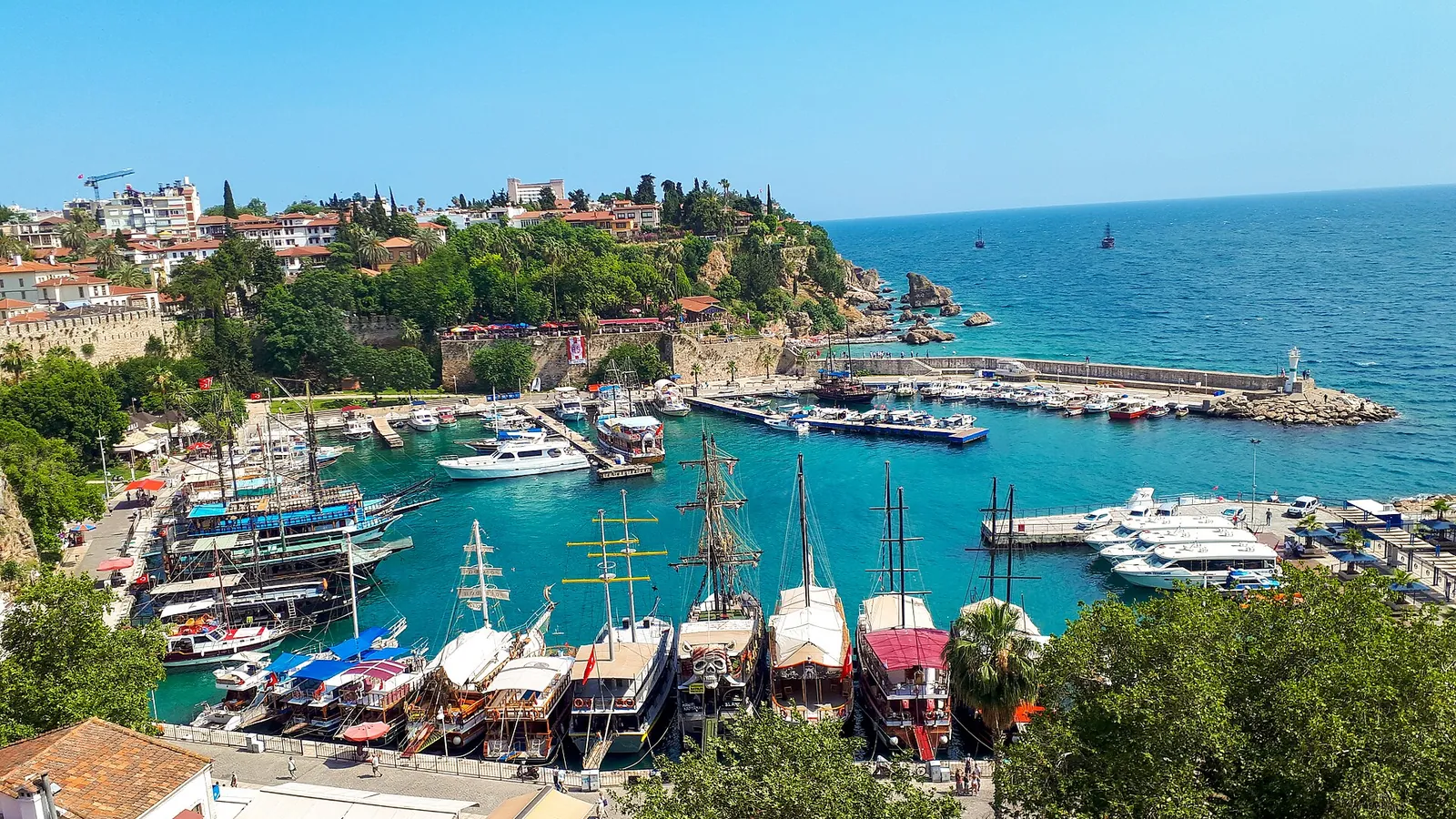
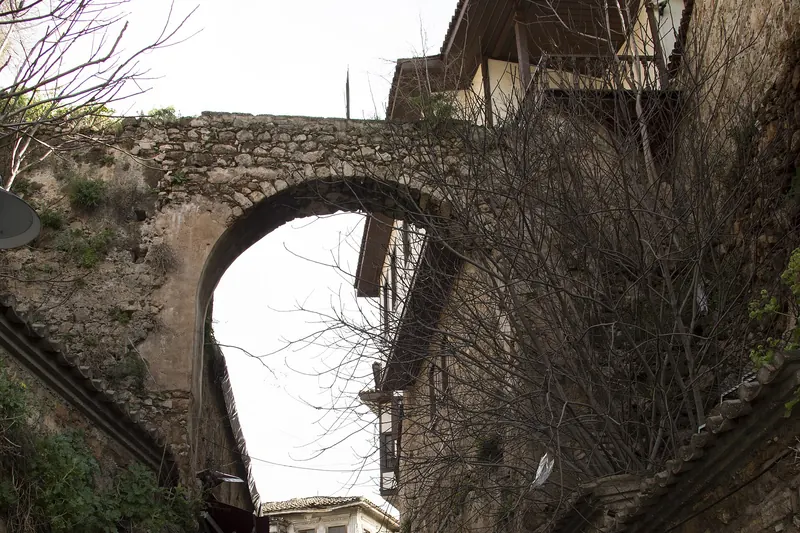
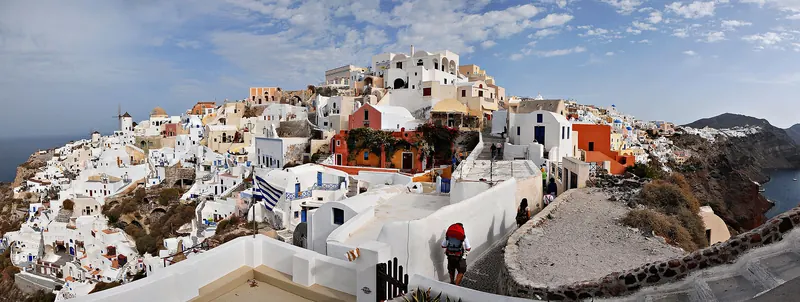
The harbour and Ottoman houses of the walled Kaleiçi quarter in Antalya

Antalya, Mediterranean · Turkey

Antalya & the Turquoise Coast

A walled Ottoman old town on a cliff above the Mediterranean, with mountains behind it and Roman theatres within an hour.

  • Best time April–June and September–October
  • Stay 3–4 days
  • Good for Beaches with ruins, families, winter sun, road trips

Photo: REHBER0770 · CC BY-SA 4.0

Welcome to Antalya

Antalya receives more international visitors than almost anywhere in Turkey — well over ten million a year — and the overwhelming majority of them go straight from the airport to a resort along the coast and never see the city. That is a genuine loss, because Antalya has a walled Ottoman quarter on a cliff above a Roman harbour, the best archaeological museum in the country, and a mountain range rising to 3,000 metres directly behind it.

The old town, Kaleiçi, is a knot of narrow lanes inside surviving Roman and Ottoman walls, with restored wooden houses, a Roman triumphal arch built for Hadrian's visit in 130 AD, and a fluted minaret that is the city's emblem. It sits on cliffs above a small harbour, and the coast either side of it is limestone cliff rather than beach, with waterfalls dropping directly into the sea.

What makes the region rewarding is the density of classical sites in the plain behind. Perge, Aspendos, Side and Termessos are all within an hour or so, and Aspendos in particular has a Roman theatre of 155 AD so complete — stage building, seating, acoustics — that it still hosts an opera festival. This is the eastern end of ancient Lycia and Pamphylia, and there is more here than most visitors realise.

  • Coast & Beaches
  • Major City
  • Archaeology
  • Historic Site

Why visit

Why visit Antalya?

Antalya's case is that it combines things that rarely coexist: a real city, a walled historic quarter, world-class ruins, mountains and a warm sea.

  • Aspendos is astonishingly intact

    A Roman theatre completed around 155 AD, seating some 12,000, with the stage building still standing to its full height — one of only a handful anywhere. The acoustics are so good it is still used for concerts, and the Ottomans used it as a caravanserai, which is why it survived.

  • The Antalya Museum is the best in Turkey

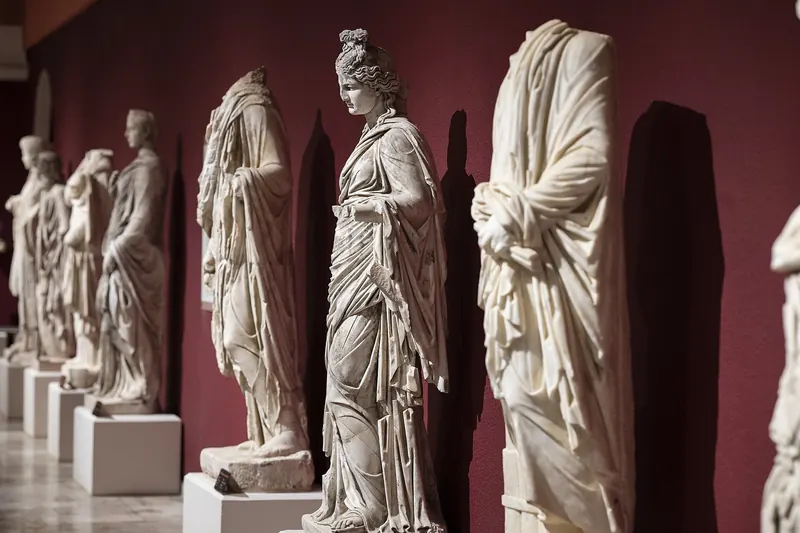
    Outside Istanbul and Ankara, this is the country's finest archaeological collection — Roman statuary from Perge in extraordinary condition, including the Weary Herakles and a hall of emperors and gods.

  • Kaleiçi is a preserved quarter

    Roman walls, Hadrian's Gate of 130 AD, Ottoman wooden houses on narrow lanes, and a horseshoe-shaped harbour below the cliffs. Restored rather than reconstructed, and a real neighbourhood rather than a museum.

  • Mountains behind the beach

    The Taurus range rises to over 3,000 metres within 50 km of the coast, which means canyons, waterfalls, alpine plateaus and — in spring — the possibility of skiing in the morning and swimming in the afternoon.

  • It works as a winter destination

    Antalya averages 15–17°C in January with a great deal of sun. The sea is too cold to swim but the ruins are empty, prices are low and the city is fully functional.

Main attractions

Top things to see in Antalya

Kaleiçi and the museum fill a day. The Roman sites in the plain behind need a car or a tour and are the reason to stay longer.

  1. Kaleiçi old town

    The walled quarter on the cliff, with lanes of restored Ottoman houses, the Roman-era harbour below, the fluted Yivli Minare of 1230, and the Kesik Minare — a building that has been a Roman temple, a Byzantine church and a mosque.

    Tip Wander without a route. The lanes are short and you will emerge at the walls or the cliff edge within a few minutes whichever way you go.

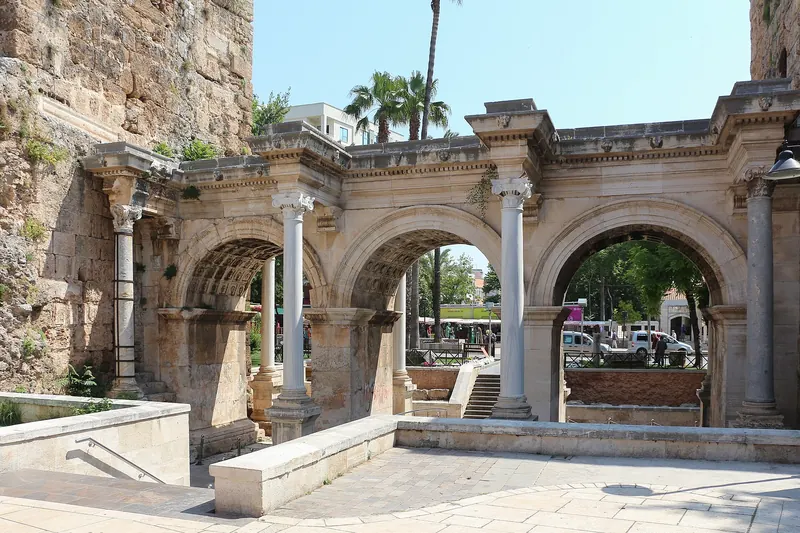
  2. The triple marble arches of Hadrian's Gate in Antalya

    Hadrian's Gate

    A triple-arched marble gateway built in 130 AD for the emperor's visit, set into the old city walls, with the original Roman road surface visible beneath it — deeply rutted by cartwheels.

    Tip The rutted paving is the detail most people miss. Look down as you walk through.

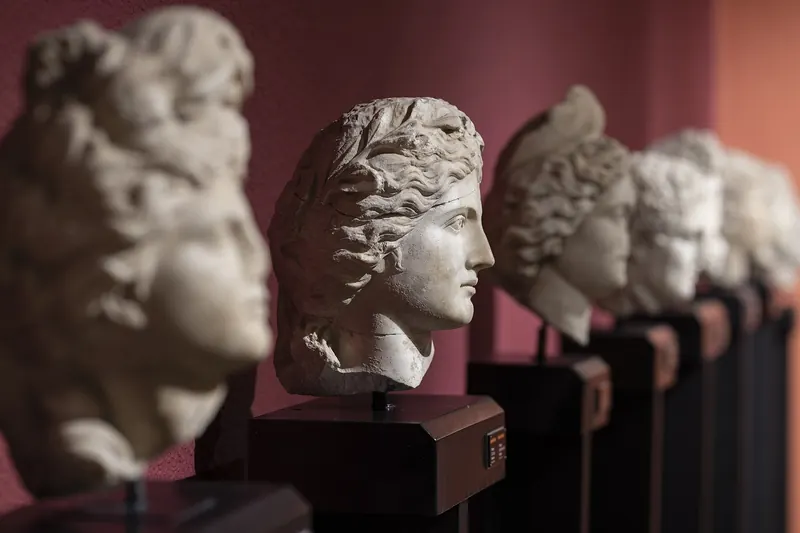
  3. Roman statuary in the Antalya Archaeological Museum

    Antalya Archaeological Museum

    Thirteen galleries covering the region from prehistory to the Ottomans, with an outstanding hall of Roman statuary excavated at Perge — emperors, gods and dancers in near-perfect condition — plus sarcophagi and a room of Byzantine icons.

    Tip Two hours minimum. Do it before visiting Perge, which makes the empty site far more legible.

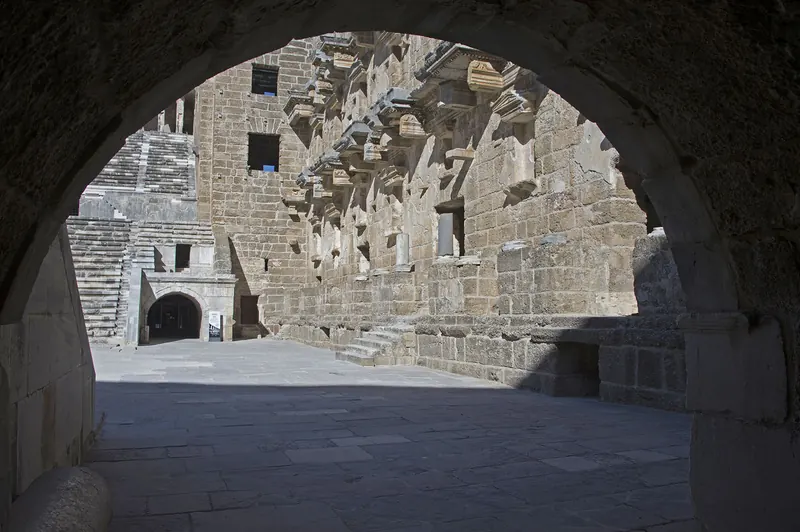
  4. The intact Roman theatre at Aspendos

    Aspendos

    Forty-five kilometres east, a Roman theatre of about 155 AD seating 12,000, with the stage building intact to its full height — vanishingly rare. It survived because the Seljuks used it as a caravanserai and maintained it.

    Tip Stand at the top and have someone speak from the stage. The acoustics work. The aqueduct nearby is also substantial.

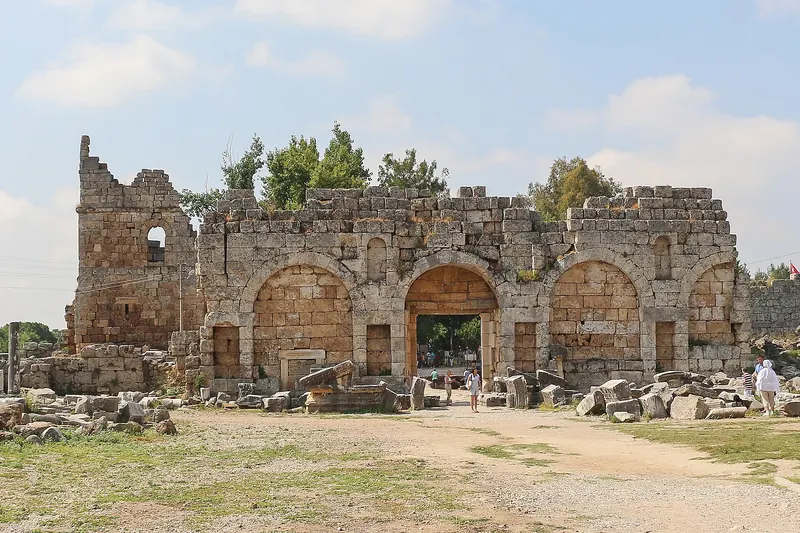
  5. The Roman gate and colonnaded street at Perge

    Perge

    Eighteen kilometres east, a large Roman city with a colonnaded main street complete with the water channel that ran down its centre, a stadium seating 12,000, monumental gates and extensive baths.

    Tip Much of the statuary now in the Antalya Museum came from here. Very little shade — go early.

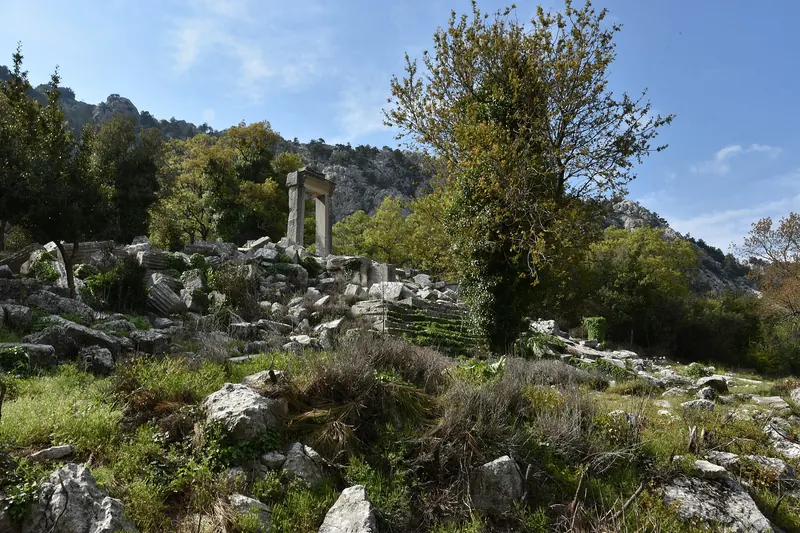
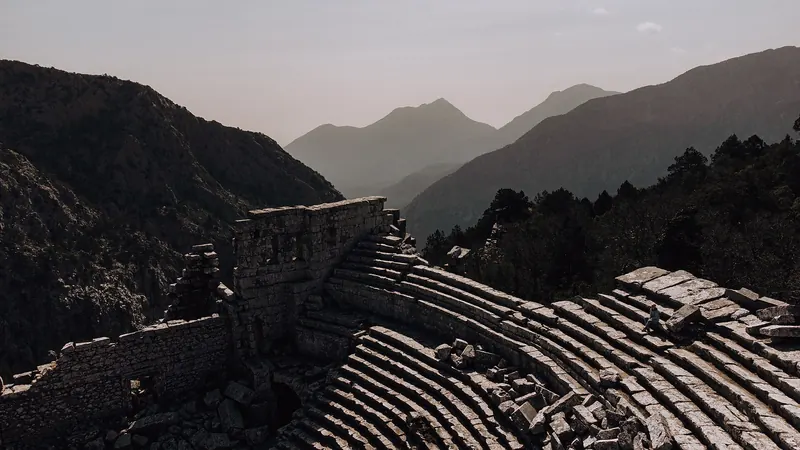
  6. Ruins scattered through pine forest at Termessos

    Termessos

    A Pisidian city high in the Taurus mountains at about 1,000 m, which Alexander the Great declined to besiege. Ruins scattered across a forested mountainside, with a theatre on the edge of a precipice.

    Tip A steep 30-minute climb from the car park. Far and away the most dramatically sited ruin in the region and the least visited.

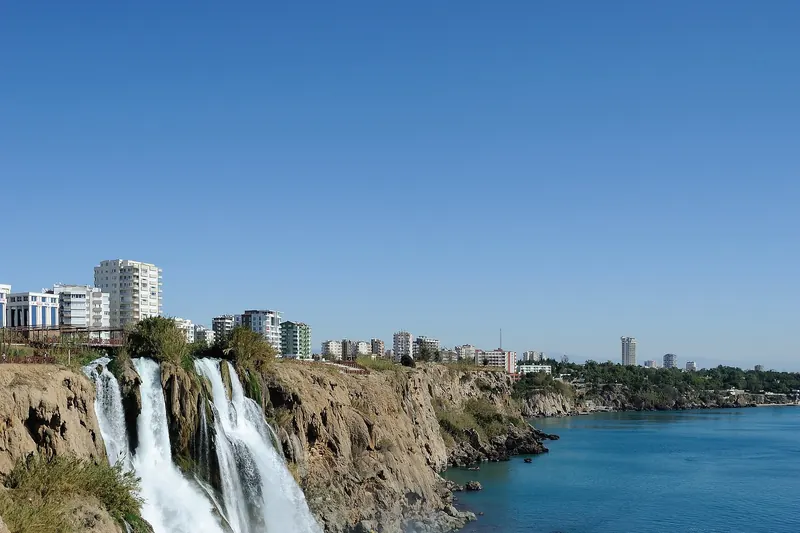
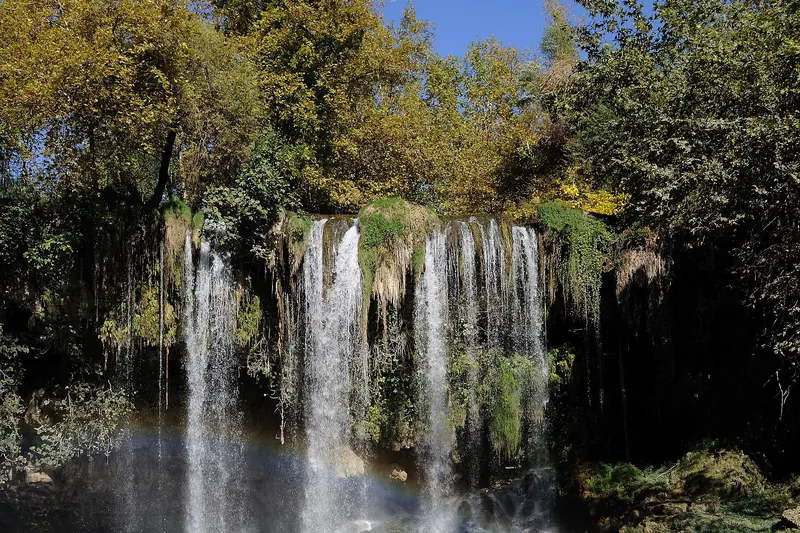
  7. The Lower Düden waterfall dropping into the sea

    The waterfalls

    The Düden falls drop directly into the sea from a cliff on the city's eastern edge, and an upper section falls into a pool you can walk behind. The Kurşunlu falls sit in a wooded canyon 20 km inland.

    Tip The Lower Düden falls are best seen from a boat. The upper falls and Kurşunlu are pleasant, shaded and easily reached.

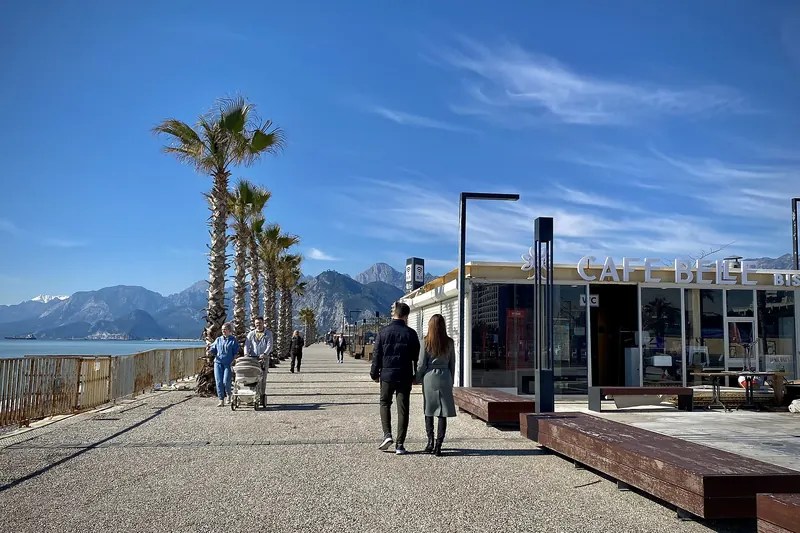
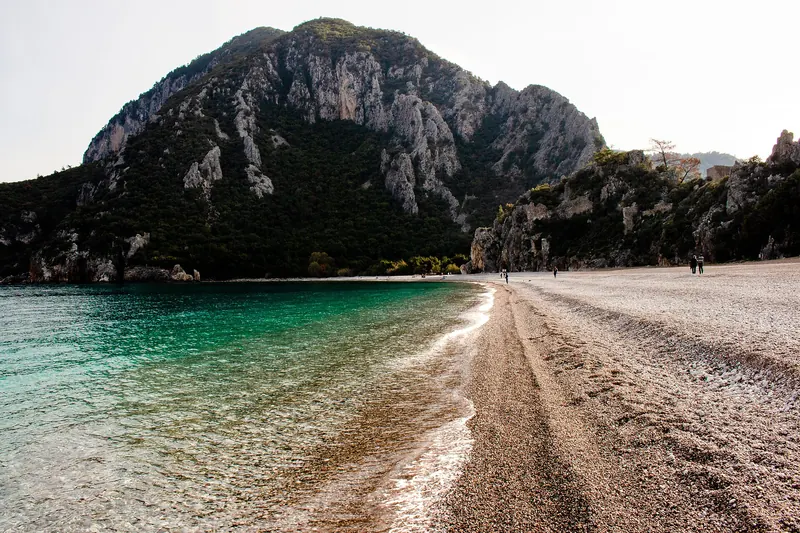
  8. Konyaaltı beach below the Taurus mountains

    The beaches

    Konyaaltı west of the city is a long pebble beach beneath the mountains; Lara to the east is sand. Both are city beaches with full facilities. The better swimming is west towards Kemer and Olympos.

    Tip Konyaaltı has the mountain backdrop and is a short tram ride from Kaleiçi.

Things to do

Best things to do in Antalya

Antalya works best as a base: the city itself for a day and a half, and everything else as excursions inland or along the coast.

  1. The old walls and gate of Antalya's Kaleiçi quarter

    Walk Kaleiçi and the harbour

    The walled quarter takes a couple of hours to wander, ending at the cliff-top park or down at the harbour. Hadrian's Gate, the two minarets and the Ottoman houses are all within a few hundred metres.

    Tip Early morning or after 18:00. Midday in the lanes is hot and the restaurants are at their most persistent.

  2. A gallery of statues in the Antalya Museum

    Do the museum then the ruins

    The Antalya Museum holds the statues taken from Perge, so seeing it first turns an empty colonnaded street into a place you can populate. Then Perge in the morning and Aspendos in the afternoon.

    Tip A full day for the museum plus both sites, ideally with a car. Neither site has shade.

  3. The mountains of Güllük Dağı national park around Termessos

    Climb to Termessos

    A mountain city at 1,000 metres in a national park, with ruins scattered through pine forest and a theatre perched above a drop. A steep half-hour climb, and you may have it entirely to yourself.

    Tip Take water and proper shoes. Cooler than the coast, and best in spring when the wildflowers are out.

  4. The Düden falls on the Antalya coast

    Take a boat along the cliffs

    Boats leave the old harbour for the Lower Düden waterfall, the cliffs and the coves west towards Kemer. Half-day and full-day trips, with swimming stops.

    Tip The waterfall dropping straight into the sea can only be seen properly from the water.

  5. The beach at Çıralı on the Lycian coast

    Head west into Lycia

    The coast road west through Kemer, Olympos and Çıralı — where the Chimaera flames burn naturally from the rock — and on to Kaş and Fethiye. One of the great Mediterranean drives.

    Tip The Chimaera flames are best after dark, a 30-minute walk uphill from Çıralı. Take a torch.

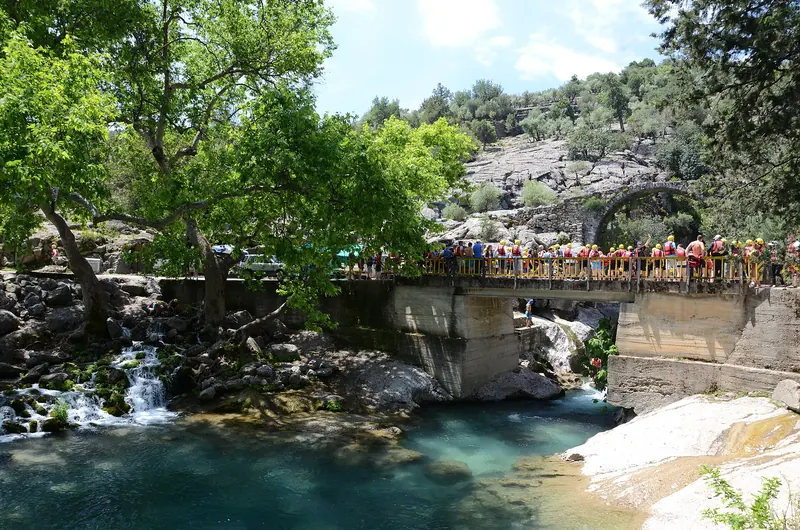
  6. The Roman bridge over the Köprülü Canyon in the Taurus

    Go up into the Taurus

    Köprülü Canyon for rafting, the Saklıkent gorge, alpine plateaus called yayla where families move flocks in summer, and a ski resort at Saklıkent 50 km from the beach.

    Tip In March you can ski in the morning and swim in the afternoon. It is a local point of pride.

Local food

What to eat in Antalya

Antalya's cooking is Mediterranean Turkish — olive oil, citrus, fish and vegetables — with strong influences from the mountain villages behind the coast.

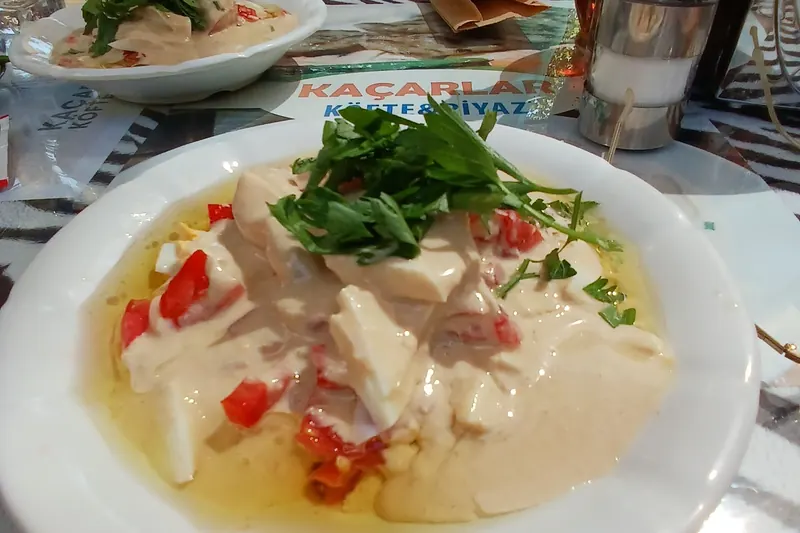
  • Antalya piyaz — white beans dressed with tahini

    Piyaz

    The Antalya version is quite different from elsewhere: white beans with tahini, garlic, lemon and vinegar, topped with egg, and served as a substantial dish rather than a side. Traditionally eaten with köfte.

    Where to try it Traditional restaurants in and around Kaleiçi. Ask for Antalya piyazı specifically.

  • Grilled fish

    Sea bass, bream and in season the migratory fish of the Mediterranean, grilled whole with lemon and rocket. Simple and dependent entirely on freshness.

    Where to try it The old harbour and the fish restaurants along the Konyaaltı seafront.

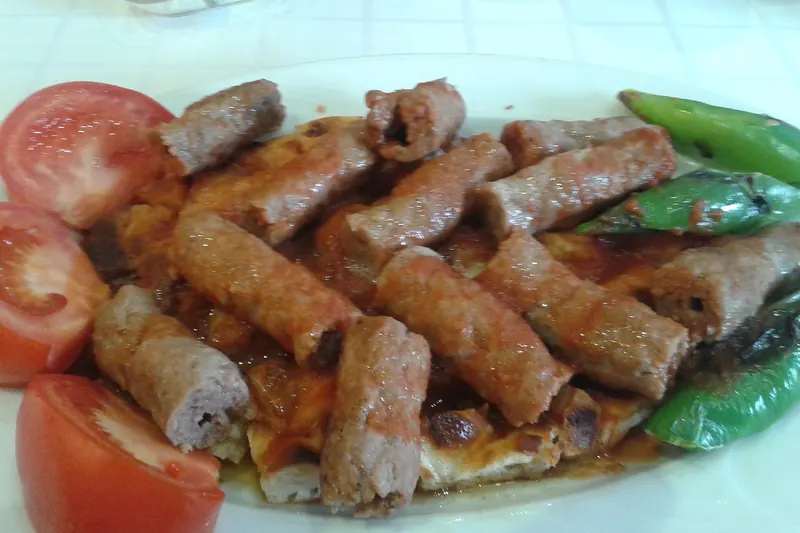
  • Şiş köfte, grilled minced lamb on skewers

    Şiş köfte and tandır

    Grilled minced lamb on skewers and slow-cooked pit-oven meat, both staples of the mountain villages behind the coast and served throughout the city.

    Where to try it Grill houses away from the harbour, where the prices are half and the meat is better.

  • Citrus

    Antalya province grows a large share of Turkey's oranges, lemons and pomegranates. Fresh juice is sold from carts everywhere, pressed in front of you for very little.

    Where to try it Street carts throughout the city, and the roadside stalls on the way to Perge and Aspendos.

  • Hibeş and mountain meze

    Hibeş is a tahini, garlic and cumin dip specific to Antalya, served with bread. It appears alongside the standard Mediterranean meze of aubergine, yoghurt and herbs.

    Where to try it Meyhanes and traditional restaurants. Ordered as part of a meze spread.

  • Bici bici and dondurma

    Bici bici is a summer dessert of shaved ice with rose syrup and starch cubes, from nearby Mersin. Maraş dondurma is the stretchy mastic ice cream sold by vendors who make a performance of handing it over.

    Where to try it Street stands along the seafront and in Kaleiçi, from late spring through summer.

Accommodation

Where to stay in Antalya

Kaleiçi's converted Ottoman houses are the best places to stay in Antalya and are far more interesting than the resort strips either side of the city.

  • Kaleiçi

    Restored Ottoman houses converted into small hotels inside the walled old town, with courtyards, pools and the harbour below. Atmospheric, central and walkable to everything in the city.

    Best for: The best base by a wide margin

  • Konyaaltı

    West of the centre along a long pebble beach with the Taurus rising behind it, and the archaeological museum at its eastern end. A tram ride from Kaleiçi and more modern in feel.

    Best for: The beach and the mountains

  • Lara

    East of the city, with sand rather than pebbles and a strip of large all-inclusive resorts. Convenient for the airport and for Perge and Aspendos, less so for the old town.

    Best for: Sandy beach and large hotels

  • Kemer and Olympos

    Forty minutes to an hour and a half west, where the mountains meet the sea. Olympos and Çıralı in particular have treehouse guesthouses, ruins in the woods and the Chimaera flames.

    Best for: The Lycian coast

  • Side

    An hour east, a resort town built among and around a Roman city, with a temple of Apollo on the point and a theatre in the middle of the shopping streets. Busy and striking.

    Best for: Ruins on a beach

What a night costs

Pension in Kaleiçi
€30–60 per night
Boutique Ottoman house hotel
€70–150 per night
All-inclusive resort
€80–200 per night, often cheaper booked as a package
Site entry
€10–20 each for Aspendos, Perge and Termessos

Transport

Getting to and around Antalya

Antalya's airport is one of the busiest in Turkey, handling enormous charter volumes from Europe alongside scheduled flights.

Getting there

  • Antalya Airport (AYT)

    Thirteen kilometres east of the city, with direct flights from across Europe and Russia plus frequent domestic services. The tram connects to the city centre in about 40 minutes.

    Extremely busy in summer with charter traffic. Allow extra time at check-in and passport control.

  • Bus

    Antalya's otogar connects to everywhere. Fethiye is about 4h along the coast road, Pamukkale & Hierapolis 4h30, Cappadocia 9h and Istanbul 12h overnight.

    The coastal bus west to Fethiye is slow and spectacular. Sit on the right.

  • By car

    Essential for Termessos and useful for Aspendos and Perge. The coast road west towards Kaş and Fethiye is one of the great Mediterranean drives.

    Hire at the airport. Roads are good and the mountain sections are winding but well surfaced.

  • Onward along the coast

    West through Kemer, Olympos, Kaş and Kalkan to Fethiye, about 4h with stops, or east to Side and Alanya.

    Antalya is the eastern anchor of the Turquoise Coast route and Fethiye the western.

Getting around

Kaleiçi is walkable and the tram covers the city. The ruins inland need a car or an organised tour.

  • Walking Kaleiçi

    The old town is only a few hundred metres across and entirely pedestrian in its core, dropping steeply to the harbour. Everything within it is five minutes from everything else.

    Lanes are cobbled and steep in places. The harbour is reached by stairs or a lift.

  • The tram

    A modern line runs from the airport through the city past the museum to Konyaaltı, plus a heritage tram along the seafront through Kaleiçi.

    Cheap and straightforward. The nostalgic tram is slow and largely for the view.

  • Rental car

    The practical way to reach Termessos, Perge, Aspendos and the Lycian coast west. Distances are short — Perge is 20 minutes, Aspendos 45.

    Parking in Kaleiçi is very limited. Most old-town hotels arrange something nearby.

  • Organised tours

    Half and full-day trips cover Perge, Aspendos and Side together, or Termessos with the waterfalls. A reasonable option without a car.

    The standard Perge–Aspendos–Side tour is efficient but rushed. Two sites in a day is better.

  • Dolmuş and buses

    Minibuses run east and west along the coast and inland to the villages. Perge is reachable by dolmuş; Aspendos and Termessos really are not.

    Fine for the beaches and the nearer sites, impractical for the mountains.

When to go

Best time to visit Antalya

Antalya has the warmest winters in Turkey and hot summers. The shoulder seasons give you swimmable sea and bearable ruins at the same time, which July does not.

  • Spring (April–June)

    Best time

    The best window: 20–30°C, wildflowers in the mountains, sea warm enough to swim from late May, and the archaeological sites comfortable. In March you can ski and swim on the same day.

  • Summer (July–August)

    Think twice

    Hot and humid at 33–40°C, with the resort coast at capacity and prices at their peak. The sea is lovely; Perge and Aspendos in the middle of the day are unwise.

  • Autumn (September–October)

    Best time

    The pick of the year. Sea at its warmest in September, heat easing, crowds gone after the first week, and the Aspendos opera festival in the theatre. October is still swimmable.

  • Winter (November–March)

    Good

    The mildest winter in Turkey at 15–17°C with a lot of sun. Too cold to swim, but the ruins are empty, the city is fully open, and prices are at their lowest. Snow on the Taurus behind the beach.

Worth planning around: Perge, Aspendos and Termessos have almost no shade. In summer they should only be visited at opening or in the last two hours, and Termessos involves a steep climb that is hard in the heat.

Itinerary

Four days in Antalya and around

The city and museum first, then the Roman sites, then the mountains and the coast. Assumes a Kaleiçi base and a hire car from day two.

  1. Day1

    Kaleiçi

    The walled town, the harbour and the museum.

    • Morning Hadrian's Gate, the Yivli Minare and the lanes of the old town.
    • Afternoon The Antalya Archaeological Museum — two hours, and the best in the country outside the capitals.
    • Evening The harbour at sunset, then dinner in Kaleiçi.
  2. Day2

    Perge and Aspendos

    Two Roman cities, both needing an early start.

    • Morning Perge at opening — the colonnaded street, the stadium and the baths.
    • Afternoon Aspendos and its intact theatre, plus the aqueduct nearby.
    • Evening Back to Antalya, or continue to Side for the temple on the point at sunset.
  3. Day3

    Termessos and the waterfalls

    Up into the Taurus, where it is cooler.

    • Morning Termessos — a steep climb to a mountain city Alexander declined to besiege.
    • Afternoon The Kurşunlu or Upper Düden waterfalls, both shaded and easy.
    • Evening Konyaaltı beach for a swim beneath the mountains.
  4. Day4

    West into Lycia

    The coast road, and the flames.

    • Morning Drive west through Kemer to Olympos — ruins scattered through woodland behind a beach.
    • Afternoon Swim at Çıralı, then rest before dark.
    • Evening The Chimaera flames after sunset, a 30-minute uphill walk with a torch.

Travel tips

Antalya travel tips

Antalya specifics, several of which are about not wasting the city itself.

  • Stay in Kaleiçi rather than the resort strips. Converted Ottoman houses inside the walls cost less than the all-inclusives, put you in a genuine old town, and are the main reason Antalya is more than an airport.
  • Visit the Antalya Museum before Perge. Almost all the statuary from the site is in the museum, so seeing it first turns an empty colonnaded street into somewhere you can picture populated.
  • Aspendos, Perge and Termessos have essentially no shade. Go at opening or in the last two hours, and treat midday in July and August as unusable.
  • Termessos needs a car and a steep thirty-minute climb, and it is the most dramatically sited ruin in the region with almost nobody there. Take water and proper shoes.
  • The Chimaera flames at Çıralı burn naturally from the rock and are best after dark, reached by a 30-minute uphill walk. Take a torch — there is no lighting on the path.
  • The coast road west towards Kaş and Fethiye is one of the great Mediterranean drives and is worth doing even as an out-and-back day trip if you are not continuing.
  • Antalya's airport handles enormous charter volumes in summer. Allow substantially more time than usual for check-in and passport control between June and September.
  • Ask for Antalya piyazı specifically — the local version with tahini is quite different from the plain bean salad served elsewhere in Turkey, and it is a proper dish rather than a side.

FAQ

Antalya: frequently asked questions

Is Antalya worth visiting or is it just a resort?

The resort strips either side of the city are exactly what their reputation suggests, but Antalya itself has a walled Ottoman old town on a cliff above a Roman harbour, the best archaeological museum in Turkey outside Istanbul and Ankara, and four major classical sites within an hour. Staying in Kaleiçi rather than an all-inclusive changes the trip entirely.

What are the best Roman sites near Antalya?

Aspendos, 45 minutes east, has a theatre from about 155 AD with its stage building intact to full height — one of very few anywhere — and it still hosts concerts. Perge, 20 minutes east, is a large city with a colonnaded street and a stadium. Termessos, an hour inland at 1,000 m in the mountains, is the most dramatic and the least visited.

When is the best time to visit Antalya?

April to June and September to October. Spring gives wildflowers in the Taurus and comfortable conditions for the ruins, with the sea swimmable from late May. September has the warmest sea of the year. Summer reaches 33–40°C, which makes the unshaded archaeological sites unwise in the middle of the day. Winter is the mildest in Turkey at 15–17°C.

Where should I stay in Antalya?

Kaleiçi, the walled old town, where Ottoman houses have been converted into small hotels with courtyards and pools. It is central, atmospheric, walkable to the harbour and the museum, and considerably more interesting than the resort strips at Lara or Belek. For a beach-focused stay, Konyaaltı has the mountain backdrop and a tram into the old town.

Can you swim in Antalya?

Yes, from late May to late October. Konyaaltı west of the city is a long pebble beach with the Taurus mountains rising behind it; Lara to the east is sand. Both are city beaches with full facilities. The better swimming is west towards Kemer, Olympos and Çıralı, where the mountains come down to the sea.

What are the Chimaera flames?

Natural flames burning from vents in the rock above Çıralı, an hour and a half west of Antalya, fuelled by methane seeping from underground. They have burned continuously for thousands of years and gave rise to the myth of the Chimaera. Best seen after dark, reached by a 30-minute uphill walk — take a torch, as the path is unlit.

How do you get from Antalya to Fethiye?

About four hours by road along the coast, through Kemer, Olympos, Kaş and Kalkan — one of the great Mediterranean drives, and worth doing slowly with stops. Buses run frequently and take a little longer. Antalya and Fethiye are the two anchors of the Turquoise Coast, and the road between them is much of the point.

Read next

Related travel articles

Seasons

The Best Time to Visit Southern Europe

Southern Europe has one obvious peak season and one much better one. This is the month-by-month case for going in spring or early autumn — plus the handful of things that only happen in July and August.

Heritage

UNESCO Sites Worth Planning a Trip Around

A UNESCO listing tells you a place matters; it does not tell you whether it is worth two days and a detour. This is how to read the list usefully — and which sites reward building a trip around them.

Where to go

Beyond the Big Names: Places Worth the Detour

The most visited place in a country is rarely its best, and it is almost never its best value. This is a method for finding the destinations that do not make the postcards — and a set of examples from five of the 50 countries on this site.

Advertisement