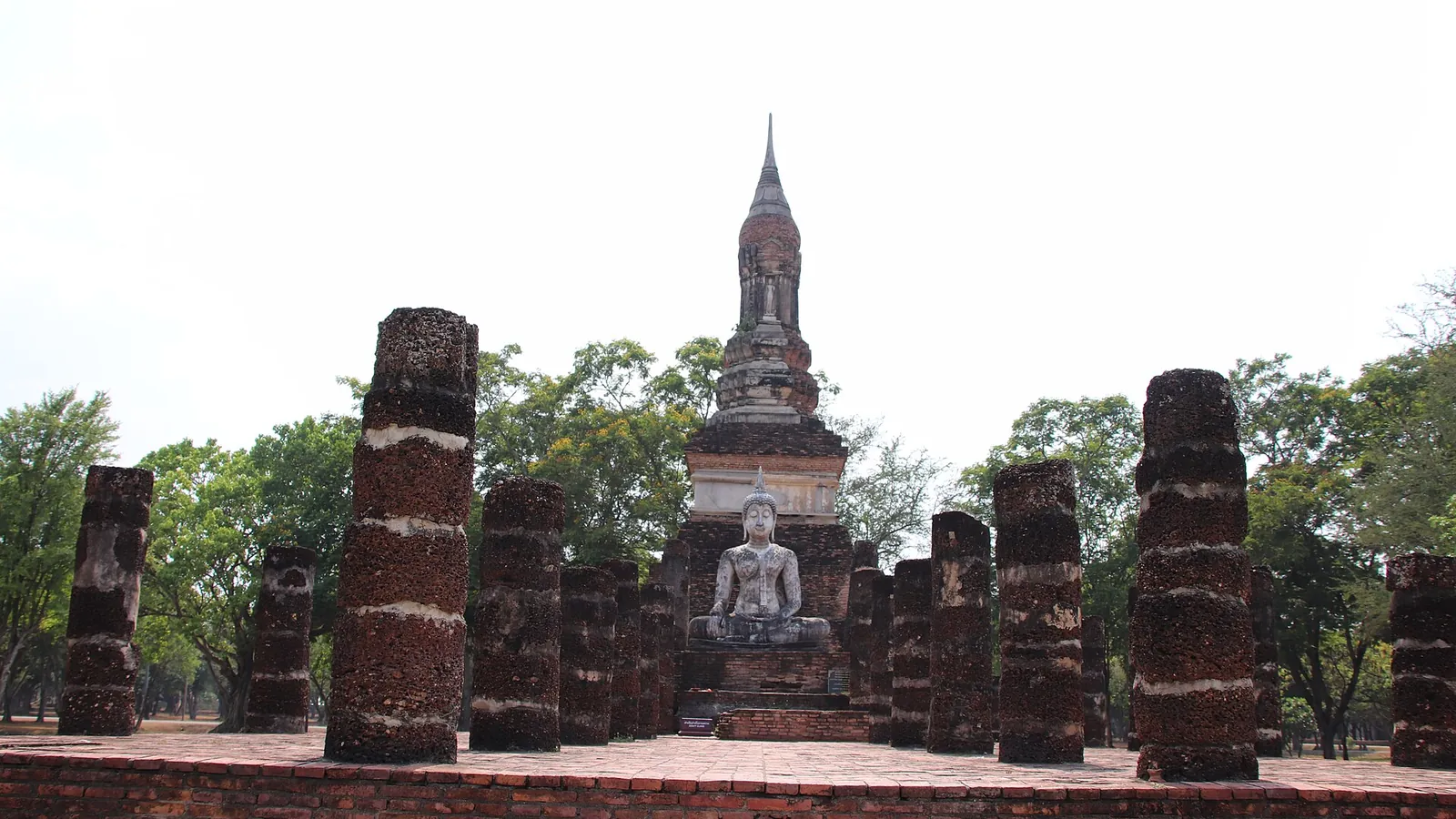
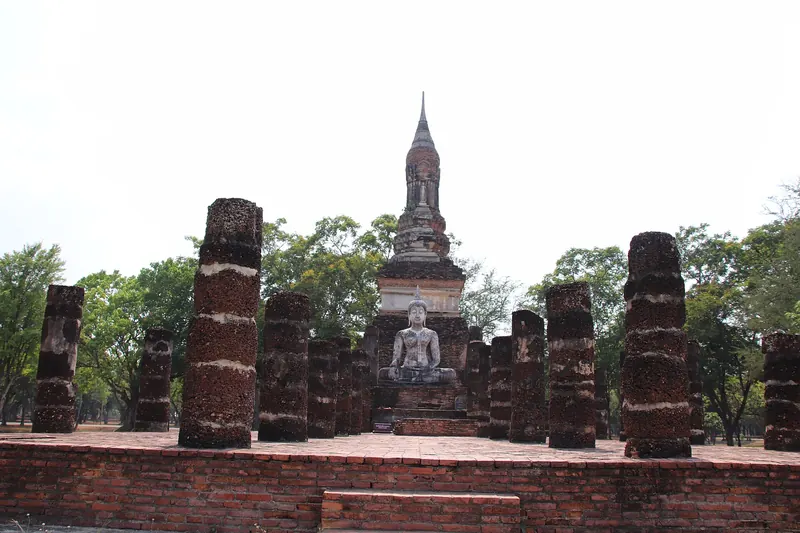
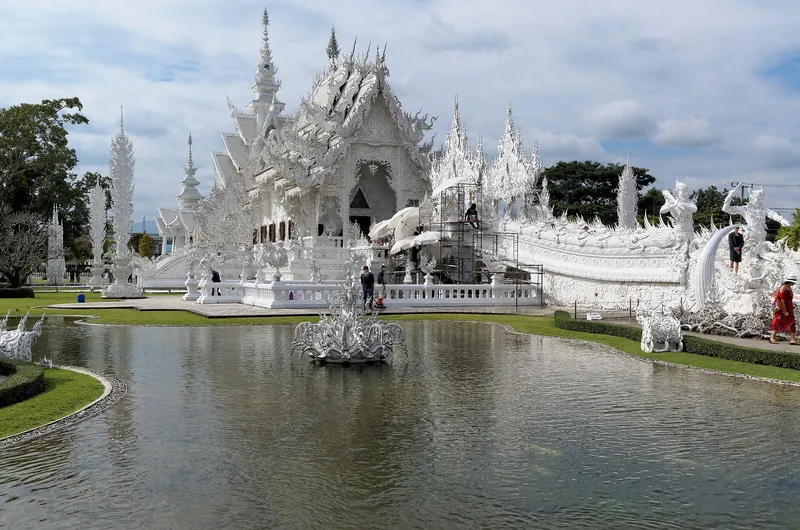
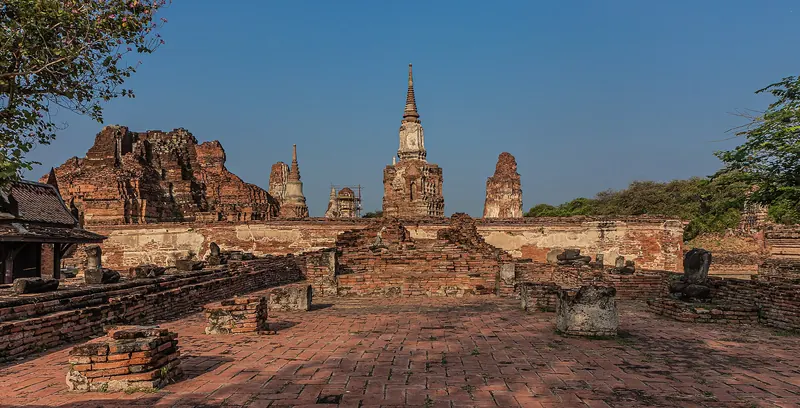
The lotus-bud chedi and Buddha statues of Wat Mahathat in Sukhothai Historical Park

Northern Thailand · Thailand

Sukhothai

The peaceful ruins of Thailand's first independent kingdom, its lotus-bud chedis reflected in still ponds with a fraction of Ayutthaya's crowds.

  • Best time November–February, for cool mornings and clear skies over the ruins
  • Stay 1–2 days
  • Good for History, archaeology, avoiding crowds

Photo: Gary Todd · Public domain

Welcome to Sukhothai

Sukhothai was founded around 1238 as the capital of the first independent Thai kingdom, predating Ayutthaya by over a century, and is often described as the birthplace of Thai art, architecture and the Thai alphabet, attributed to King Ramkhamhaeng's famous inscription.

The historical park that preserves the old city today is spread across a spacious, tree-lined landscape of ponds and ruined temples, its distinctive lotus-bud chedi style — a bell-shaped spire tapering to a point resembling a closed lotus bud — found nowhere else in quite this form.

Where Ayutthaya draws steady day-trip crowds from Bangkok, Sukhothai's greater distance keeps it peaceful, and cycling between its ruined temples at dawn, with mist still rising off the ponds, is one of the most understated experiences in Thailand.

  • Historic Site
  • UNESCO Site
  • Archaeology
  • Off the Beaten Path

Why visit

Why visit Sukhothai?

Sukhothai's case is that it delivers Thailand's ancient history with a fraction of the crowds found anywhere closer to Bangkok.

  • It's the birthplace of Thai civilization

    The first independent Thai kingdom, credited with the Thai alphabet and a distinctive artistic style found nowhere else.

  • The historical park is spacious and peaceful

    Tree-lined and spread across ponds, with noticeably fewer visitors than Ayutthaya's more accessible ruins.

  • The lotus-bud chedi style is distinctive

    A Sukhothai-era architectural signature, its tapering spire unlike temple styles found elsewhere in Thailand.

  • It rewards an early-morning visit like few other sites

    Dawn cycling through the mist-covered ruins, largely alone, is a memorable experience.

  • It pairs naturally with the rest of the north

    A straightforward stop between Bangkok and Chiang Mai or Chiang Rai for those exploring the north by road.

Main attractions

Top things to see in Sukhothai

Sukhothai's essential ruins, spread across the historical park's central, northern and western zones.

  1. The lotus-bud chedi and Buddha statues of Wat Mahathat in Sukhothai Historical Park

    Wat Mahathat

    The historical park's central and most important temple, its lotus-bud chedi surrounded by rows of seated Buddha statues and reflected in a wide pond.

    Tip Arrive at opening time for the calmest reflections in the pond and the softest morning light on the chedi.

  2. Wat Si Chum

    Home to a colossal seated Buddha statue, Phra Achana, visible through a narrow slit in the surrounding structure's walls, striking in scale.

    Tip Look up at the ceiling of the narrow passage beside the statue for faint traces of engraved Jataka tale illustrations.

  3. Wat Sa Si

    A picturesque temple set on an island within a lake in the central zone, its single white chedi and seated Buddha statue reflected in the water.

    Tip One of the park's most photogenic spots, particularly around sunrise or sunset.

  4. Wat Si Sawai

    Three Khmer-style prang towers built originally as a Hindu shrine before later conversion to a Buddhist temple, distinct from the park's other Sukhothai-style ruins.

    Tip The contrast between this Khmer-influenced structure and the surrounding lotus-bud chedis is worth noting as you explore.

  5. Wat Phra Phai Luang

    A quiet northern-zone temple with a partially collapsed Khmer-style prang, considerably less visited than the central zone's main sites.

    Tip The northern zone requires a separate ticket from the central zone but is worth the extra stop for its emptiness.

  6. The Ramkhamhaeng National Museum

    A useful museum near the park entrance holding artefacts from the site, including a replica of the famous inscription stone attributed to King Ramkhamhaeng.

    Tip Visit before exploring the ruins for context that deepens the rest of the visit.

Things to do

Best things to do in Sukhothai

Beyond the central ruins, Sukhothai rewards cycling and its quieter old-town surroundings.

  1. Cycle the historical park at dawn

    Renting a bicycle and arriving at opening time offers a singular experience of the ruins largely to yourself, mist still rising off the ponds.

    Tip Rent a bicycle the evening before from a shop near the park entrance so you can start cycling the moment it opens.

  2. Watch the light-and-sound show

    On select evenings, the historical park hosts an atmospheric light-and-sound performance among the illuminated ruins.

    Tip Check the schedule ahead, as performances run only on specific dates, often tied to festivals.

  3. Visit the Sangkhalok Kilns and ceramics museum

    Sukhothai-era ceramics, prized historically as a major export, are preserved and explained at a small dedicated museum near the old kiln sites.

    Tip A worthwhile stop for anyone with even a passing interest in the kingdom's trade history.

  4. Explore Si Satchanalai Historical Park

    A worthwhile second, considerably less visited historical park about an hour from Sukhothai, sharing the same era and architectural style.

    Tip Combine with Sukhothai as a day trip if you have a car or hired driver, since public transport there is limited.

  5. Stay in Sukhothai's old town for a local evening

    The modern town near the historical park offers a quiet, low-key evening atmosphere considerably different from Chiang Mai or Bangkok's tourist strips.

    Tip A night market runs on Saturday evenings in the old town, a good lower-key alternative to Chiang Mai's version.

Local food

What to eat in Sukhothai

Sukhothai has its own distinct regional noodle dish alongside standard northern Thai fare.

  • Sukhothai noodles (kuay teow sukhothai)

    A distinctive local noodle soup with a slightly sweet broth, ground pork, green beans and crushed peanuts, found almost nowhere outside the region.

    Where to try it Local noodle shops in the new town, a genuine point of local pride.

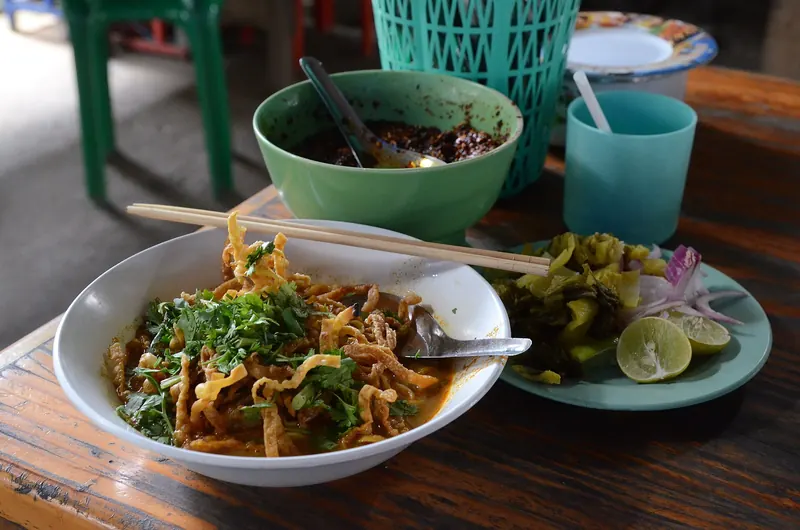
  • A bowl of khao soi, northern Thai curry noodle soup

    Khao soi

    Northern Thailand's signature curry noodle soup, available at several restaurants around Sukhothai's new town.

    Where to try it Local restaurants in the new town near the historical park.

  • Grilled river fish

    Freshwater fish from the nearby Yom River, grilled simply with herbs, a reliable local dish at riverside restaurants.

    Where to try it Restaurants along the Yom River in Sukhothai's old and new towns.

  • Thai iced tea

    Strong, sweet black tea with condensed milk over ice, a welcome break from cycling the historical park in the heat.

    Where to try it Street stalls and cafés near the historical park entrance.

  • Sticky rice with mango or banana

    A simple, satisfying dessert of sweet coconut sticky rice, available seasonally with fresh local fruit.

    Where to try it Market stalls in Sukhothai's new town, particularly in mango season from April to June.

Accommodation

Where to stay in Sukhothai

Sukhothai's old town, near the historical park, and the newer town a short distance away both work as a base.

  • Old Sukhothai (near the historical park)

    Guesthouses close to the park entrance, ideal for reaching the ruins at opening time before tour groups arrive.

    Best for: Early access to the ruins

  • New Sukhothai town

    About 12km from the historical park, with more dining options and a local, low-key evening scene.

    Best for: A wider range of restaurants and a local evening atmosphere

What a night costs

Guesthouse room
฿400–900 per night
Mid-range hotel
฿1,200–2,500 per night
Historical park entry (central zone)
฿100
Bicycle rental
฿30–50 per day

Transport

Getting to and around Sukhothai

Sukhothai is reachable by a short flight, or by bus as part of an overland route through the north.

Getting there

  • Sukhothai Airport (THS)

    Served by direct flights from Bangkok, with the airport itself an attractive, low-rise building worth noticing.

    A shuttle or taxi covers the roughly 30-minute transfer into town.

  • Bus from Bangkok or Chiang Mai

    Regular long-distance buses connect Sukhothai to Bangkok (about 6 hours) and Chiang Mai (about 5 hours).

    VIP overnight buses offer reclining seats for the longer Bangkok route.

  • Fly to Phitsanulok and transfer

    A well-connected alternative airport about an hour from Sukhothai by road, with more frequent flight options.

    Taxis and minivans cover the transfer from Phitsanulok's airport or bus station.

Getting around

The historical park's spread-out, flat layout makes bicycle the best way to explore Sukhothai.

  • Bicycle

    The classic and ideal way to explore the historical park's central, northern and western zones.

    Rentals are cheap and widely available at shops near the park entrance.

  • Songthaew between old and new town

    Shared pickup trucks run regularly between the historical park and Sukhothai's new town, a cheap local option.

    Flag one down along the main road between the two towns.

  • Tuk-tuk or hired driver for Si Satchanalai

    Useful for reaching the second, more remote historical park at Si Satchanalai, about an hour away.

    Negotiate a return fare including waiting time if visiting as a day trip.

When to go

Best time to visit Sukhothai

Sukhothai's open historical park benefits from the cool season's comfortable temperatures, particularly for an early cycling start.

  • Cool season (November–February)

    Best time

    The most comfortable weather for cycling the historical park, with cool, clear mornings.

  • Hot season (March–May)

    Shoulder

    Hot across the open park, best managed with an early morning visit before the heat peaks.

  • Rainy season (June–October)

    Good

    Lush surroundings and thinner crowds, with typically short afternoon downpours rather than all-day rain.

Worth planning around: Midday hours from March to May, when the open, largely unshaded historical park's heat can make extended cycling uncomfortable.

Itinerary

One to two days in Sukhothai

The central historical park's ruins first, then the quieter northern and western zones or a Si Satchanalai day trip.

  1. Day1

    The central historical park

    Sukhothai's essential ruins.

    • Morning Wat Mahathat and Wat Sa Si, arriving at opening time.
    • Afternoon Wat Si Sawai and the Ramkhamhaeng National Museum.
    • Evening Dinner in the new town.
  2. Day2

    The quieter zones or Si Satchanalai

    An optional second day for the park's less-visited corners.

    • Morning The northern zone's Wat Si Chum and Wat Phra Phai Luang.
    • Afternoon A day trip to Si Satchanalai Historical Park, if time allows.
    • Evening Depart, or continue north to Chiang Mai or Chiang Rai.

Travel tips

Sukhothai travel tips

Practical notes on booking, timing and transport that make a real difference to a Sukhothai trip.

  • Arrive at opening time for the calmest, coolest and least crowded visit to the central zone's ruins.
  • Rent a bicycle rather than walking — the historical park's zones are too spread out to cover comfortably on foot.
  • Buy separate tickets if visiting more than one zone (central, north, west) — they aren't automatically combined.
  • Bring water and sun protection — shade is limited across the open ruins.
  • Consider basing in the old town near the park if an early start matters more to you than dining variety.
  • Combine with Si Satchanalai if you have a car or driver, for a worthwhile, far less visited second historical park.

FAQ

Sukhothai: frequently asked questions

Is Sukhothai worth visiting compared to Ayutthaya?

Yes, if time allows both or you're already travelling in the north — Sukhothai's ruins are less crowded and arguably more atmospheric, though Ayutthaya is considerably easier to reach as a Bangkok day trip.

How many days do you need in Sukhothai?

One full day covers the central zone comfortably; two allows the quieter northern and western zones or a Si Satchanalai day trip without feeling rushed.

How do I get around the historical park?

Bicycle, the classic and most practical option — the park's zones spread out considerably more than Ayutthaya's, making cycling the most comfortable way to see everything.

Is Sukhothai easy to combine with Chiang Mai?

Yes — regular buses connect the two in about five hours, making Sukhothai a worthwhile stop on an overland route through northern Thailand rather than requiring a separate trip.

What is the best time of year to visit?

November to February offers the most comfortable weather for cycling the open historical park. March to May turns hot, making an early morning visit considerably more comfortable.

Read next

Related travel articles

Heritage

UNESCO Sites Worth Planning a Trip Around

A UNESCO listing tells you a place matters; it does not tell you whether it is worth two days and a detour. This is how to read the list usefully — and which sites reward building a trip around them.

Where to go

Beyond the Big Names: Places Worth the Detour

The most visited place in a country is rarely its best, and it is almost never its best value. This is a method for finding the destinations that do not make the postcards — and a set of examples from five of the 50 countries on this site.

Advertisement