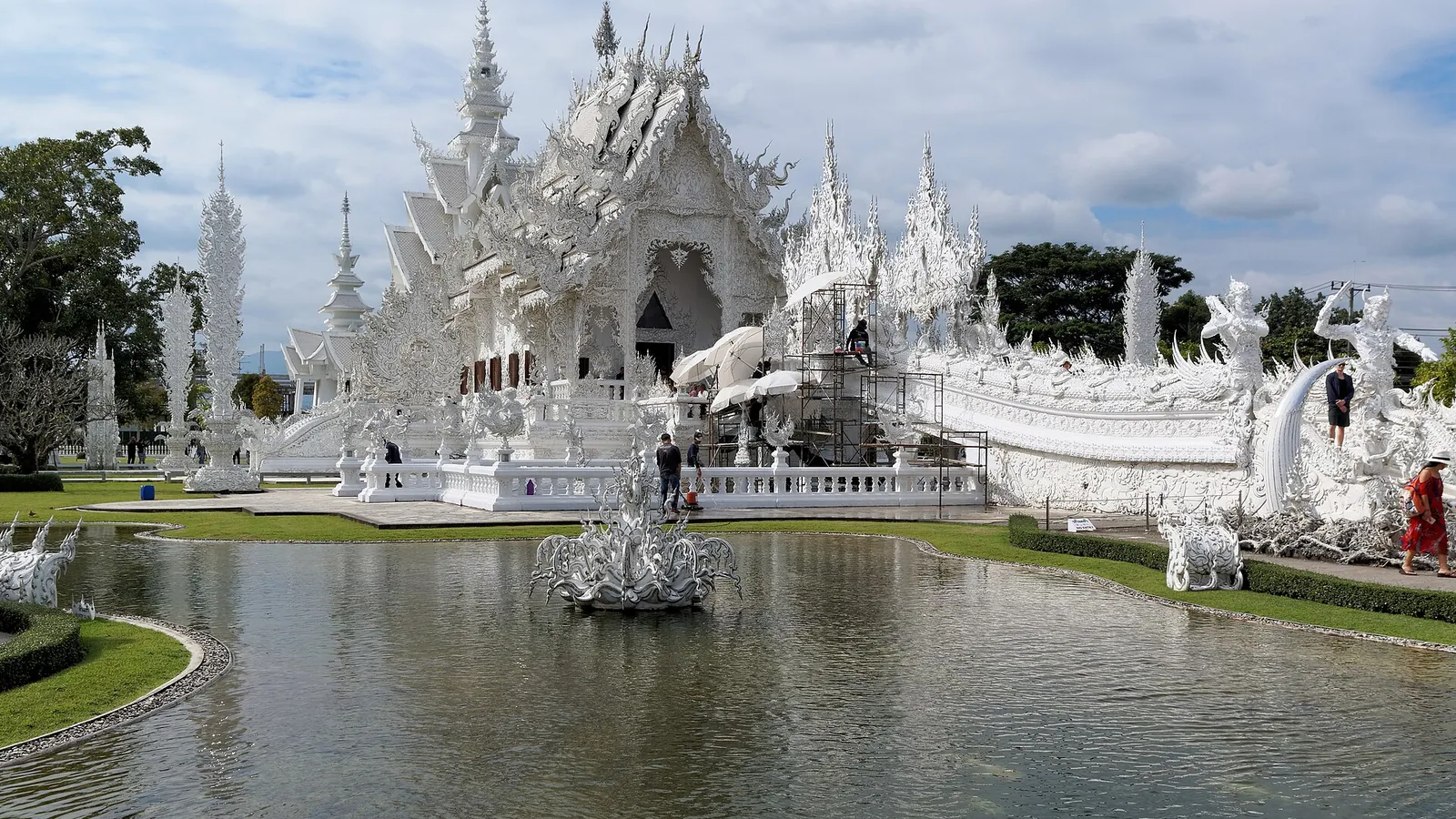
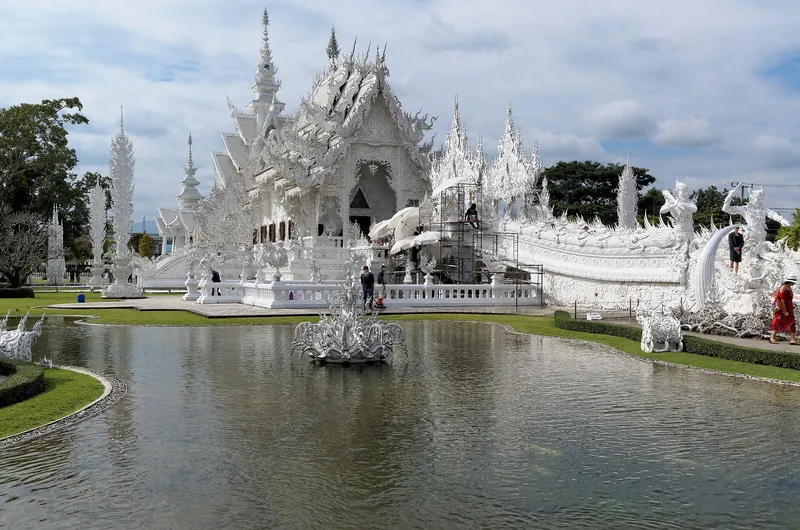
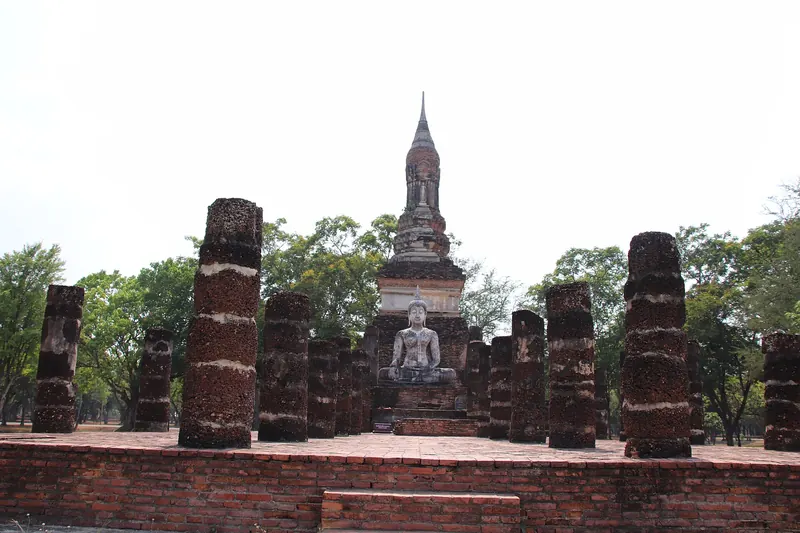
Wat Rong Khun, the White Temple, with its dazzling white facade and spires

Northern Thailand · Thailand

Chiang Rai

Thailand's far north, home to a dazzling all-white contemporary temple, a deep-blue counterpart, and the misty hills where three countries meet at the Golden Triangle.

  • Best time November–February, for cool, clear mountain weather
  • Stay 2–3 days
  • Good for Temples, art, a quieter version of the north

Photo: Jakub Hałun · CC BY-SA 4.0

Welcome to Chiang Rai

Chiang Rai sits at Thailand's northernmost frontier, a quieter and less touristed counterpart to Chiang Mai, three hours further north by road and considerably less visited despite holding some of the country's most striking contemporary religious art.

The city's defining sights aren't ancient ruins but two extraordinary modern temples built by living Thai artists — Wat Rong Khun's dazzling all-white, mirror-studded design, and Wat Rong Suea Ten's deep indigo-blue counterpart — both unlike anything else in Thailand's temple landscape.

Beyond the city, the surrounding hills hold the historic Golden Triangle, where Thailand, Laos and Myanmar meet along the Mekong River, once the heart of the regional opium trade and now a fascinating stop combining history, river views and hill-tribe culture.

  • Culture & Arts
  • Mountains
  • Off the Beaten Path
  • Historic Site

Why visit

Why visit Chiang Rai?

Chiang Rai's case is that its contemporary temples are unlike anything else in Thailand, and its frontier setting is worth the extra distance.

  • The White Temple is a singular piece of art

    Wat Rong Khun's dazzling, symbolism-laden design is unlike any traditional Thai temple, built and still expanded by a living artist.

  • It's quieter than Chiang Mai

    Fewer crowds at major sights, even at the increasingly famous White Temple, than anywhere comparable further south.

  • The Golden Triangle delivers real history

    Where three countries meet along the Mekong, once the centre of the regional opium trade, now a fascinating riverside stop.

  • The surrounding hills offer genuine hill-tribe culture

    Akha, Karen and other communities in the hills around the city offer a less commercialised alternative to Chiang Mai's trekking circuit.

  • It pairs naturally with the rest of the north

    An easy few hours by road from both Chiang Mai and Sukhothai for those exploring the region overland.

Main attractions

Top things to see in Chiang Rai

Chiang Rai's essential sights, spanning its striking modern temples and the Golden Triangle beyond the city.

  1. Wat Rong Khun, the White Temple, with its dazzling white facade and spires

    Wat Rong Khun (the White Temple)

    An extraordinary contemporary temple designed by artist Chalermchai Kositpipat, its all-white, mirror-studded facade and symbolic bridge over a sea of reaching hands unlike any traditional Thai temple.

    Tip Visit early morning to beat the tour-bus crowds — the White Temple has become popular and can feel packed by midday.

  2. Wat Rong Suea Ten (the Blue Temple)

    A striking, deep indigo-blue temple with gold accents, a photogenic counterpart to the White Temple built by a student of the same artistic tradition.

    Tip The interior's giant white Buddha statue against the blue and gold walls is worth stepping inside for.

  3. Baan Dam Museum (the Black House)

    An unusual complex of dark wooden buildings filled with animal bones, skins and unsettling artwork by artist Thawan Duchanee, a deliberate artistic counterpoint to the White Temple's purity.

    Tip Give yourself at least an hour — the sprawling complex of over 40 buildings rewards an unhurried wander.

  4. The Golden Triangle

    Where the Mekong and Ruak rivers meet at the borders of Thailand, Laos and Myanmar, once the heart of the regional opium trade and now marked by a giant golden Buddha statue and river viewpoints.

    Tip The Hall of Opium museum nearby offers thorough context on the region's opium trade history.

  5. Doi Mae Salong

    A mountain village settled by former Chinese Nationalist soldiers, its tea plantations and Yunnanese food culture distinct from the rest of Thailand.

    Tip Visit during tea harvest season for the terraced hillsides at their most scenic, and try the local oolong tea.

  6. Chiang Saen's ancient ruins

    An underrated riverside town near the Golden Triangle holding the ruins of an old Lanna-era city, considerably less visited than Sukhothai or Ayutthaya.

    Tip Combine with a Golden Triangle visit, since Chiang Saen sits directly along the same riverside route.

Things to do

Best things to do in Chiang Rai

Beyond the temples, Chiang Rai rewards its hill-tribe culture, tea plantations and river viewpoints.

  1. Visit a hill-tribe village responsibly

    The hills around Chiang Rai are home to Akha, Karen and other communities, and community-run visits offer genuine cultural exchange with considerably less commercialisation than around Chiang Mai.

    Tip Book through an operator with a genuine, transparent community partnership rather than a purely transactional visit.

  2. Take a Mekong River boat trip

    Boat trips from the Golden Triangle area cross briefly into Laos' Don Sao island or simply cruise the river for views of all three bordering countries.

    Tip Bring your passport if the boat trip includes a brief stop on the Laos side of the river.

  3. Visit a Chiang Rai tea plantation

    The hills around Doi Mae Salong and Doi Mae Salong's surroundings grow excellent oolong tea, with several plantations open for tastings and tours.

    Tip Choi Fah viewpoint near Doi Mae Salong offers a spectacular tea-terrace and mountain panorama.

  4. Explore Chiang Rai's night bazaar and walking street

    A smaller, considerably less crowded version of Chiang Mai's markets, with local food, crafts and live performances.

    Tip The Saturday Walking Street offers the widest range of stalls and the liveliest atmosphere.

  5. Visit the Hall of Opium museum

    A thorough, well-presented museum near the Golden Triangle covering the region's opium trade history and its modern eradication.

    Tip Allow at least ninety minutes — the museum is considerably more comprehensive than its remote location might suggest.

Local food

What to eat in Chiang Rai

Chiang Rai shares much of northern Thai cuisine, with genuine Yunnanese influence around Doi Mae Salong.

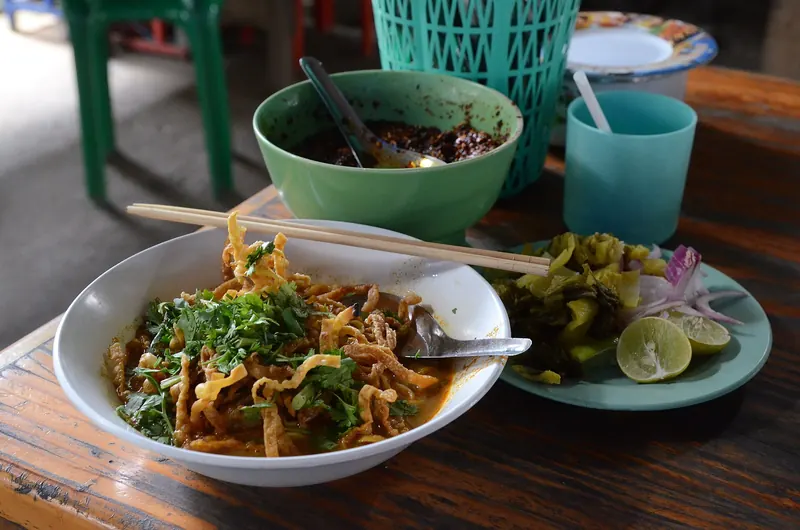
  • A bowl of khao soi, northern Thai curry noodle soup

    Khao soi

    Northern Thailand's signature curry noodle soup, widely available across Chiang Rai's restaurants and markets.

    Where to try it Local restaurants throughout the city, particularly around the night bazaar.

  • Sai oua (northern Thai sausage)

    A herb-packed grilled pork sausage, a genuine northern Thai staple found at markets and street stalls across the city.

    Where to try it The Saturday Walking Street and local markets throughout Chiang Rai.

  • Yunnanese food around Doi Mae Salong

    Doi Mae Salong's Chinese Nationalist heritage has produced a distinct local food scene, including Yunnan-style ham, noodles and mantou buns.

    Where to try it Local restaurants and market stalls in Doi Mae Salong village.

  • Oolong tea

    Highland tea grown around Doi Mae Salong, excellent and considerably less internationally known than Thailand's coffee.

    Where to try it Tea plantation shops around Doi Mae Salong, several offering free tastings.

  • Grilled Mekong river fish

    Freshwater fish from the Mekong, grilled simply with herbs, a worthwhile dish at riverside restaurants near the Golden Triangle.

    Where to try it Riverside restaurants around Chiang Saen and the Golden Triangle.

Accommodation

Where to stay in Chiang Rai

Chiang Rai's city centre and the area near Doi Mae Salong or the Golden Triangle both work as a base, depending on your priorities.

  • Chiang Rai city centre

    The most convenient base for the city's main sights, with a wide range of guesthouses and hotels.

    Best for: The White and Blue Temples, and the night bazaar

  • Near the Golden Triangle

    Resorts overlooking the Mekong, offering scenic views across to Laos and Myanmar.

    Best for: River views and border sightseeing

What a night costs

Guesthouse room
฿400–900 per night
Mid-range hotel
฿1,500–3,000 per night
White Temple entry
฿100
Khao soi bowl
฿40–60

Transport

Getting to and around Chiang Rai

Chiang Rai has its own airport with direct flights from Bangkok, or is reachable overland from Chiang Mai.

Getting there

  • Chiang Rai International Airport (CEI)

    Direct flights from Bangkok, with the airport about a 20-minute drive from the city centre.

    A metered taxi or pre-arranged hotel transfer covers the airport journey.

  • Bus from Chiang Mai

    Regular buses connect Chiang Mai to Chiang Rai in roughly 3 hours.

    A private driver or small-group tour covers the same route with worthwhile stops along the way.

  • Bus from Sukhothai

    Longer-distance buses connect Sukhothai to Chiang Rai, typically via Chiang Mai.

    Booking through to the final destination is usually simpler than arranging a separate connecting bus.

Getting around

Chiang Rai's main temples sit close to the city centre, while the Golden Triangle and Doi Mae Salong require a longer trip.

  • Songthaew or tuk-tuk within the city

    Covers the White Temple, Blue Temple and Black House, all a short distance from central Chiang Rai.

    Agree the fare before setting off, or negotiate a half-day rate covering all three main temples.

  • Rented car or private driver

    The most practical way to reach the Golden Triangle and Doi Mae Salong, both over an hour from the city.

    A hired driver for the day is often more relaxing than self-driving on unfamiliar mountain roads.

  • Scooter rental

    A popular option for confident riders wanting to explore the surrounding countryside independently.

    An International Driving Permit and a proper helmet are important on the region's mountain roads.

When to go

Best time to visit Chiang Rai

Chiang Rai's far-northern location makes its cool season cooler than the rest of Thailand, ideal for exploring the temples and surrounding hills.

  • Cool season (November–February)

    Best time

    The most comfortable weather of the year, with cool mornings and evenings in the surrounding hills.

  • Hot season (March–May)

    Shoulder

    Hot, and often affected by seasonal agricultural burning that reduces air quality and mountain views.

  • Rainy season (June–October)

    Good

    Lush green hillsides and thinner crowds, with typically short afternoon downpours.

Worth planning around: Late February to April if air quality and mountain visibility are a concern — seasonal burning across the region can affect the Golden Triangle's river views.

Itinerary

Two to three days in Chiang Rai

The city's striking temples first, then the Golden Triangle and hills beyond it.

  1. Day1

    The White and Blue Temples

    Chiang Rai's essential contemporary temples.

    • Morning Wat Rong Khun, the White Temple, arriving early.
    • Afternoon Wat Rong Suea Ten and the Baan Dam Museum.
    • Evening The night bazaar or Saturday Walking Street.
  2. Day2

    The Golden Triangle

    History and river views at Thailand's northern border.

    • Morning Drive to the Golden Triangle and the Hall of Opium museum.
    • Afternoon A Mekong River boat trip, with a stop in Chiang Saen's ruins.
    • Evening Return to Chiang Rai for a final dinner.
  3. Day3

    Doi Mae Salong or departure

    An optional third day in the tea hills, or departure.

    • Morning Drive to Doi Mae Salong's tea plantations.
    • Afternoon Explore the Yunnanese village and Choi Fah viewpoint.
    • Evening Return to Chiang Rai, or depart onward.

Travel tips

Chiang Rai travel tips

Practical notes on booking, timing and transport that make a real difference to a Chiang Rai trip.

  • Visit the White Temple at opening time to avoid the growing tour-bus crowds.
  • Hire a car or driver for the Golden Triangle and Doi Mae Salong — both are considerably too far for city-centre tuk-tuks.
  • Check air quality forecasts if visiting in March or April, when seasonal burning can affect mountain views.
  • Bring your passport if a Mekong boat trip includes a brief stop on the Laos side of the river.
  • Pack a light layer for cool-season evenings, which run cooler here than further south in Thailand.
  • Allow at least a full day for the Golden Triangle area if combining it with Chiang Saen's ruins and the opium museum.

FAQ

Chiang Rai: frequently asked questions

How many days do you need in Chiang Rai?

Two to three. Two covers the White and Blue Temples plus a Golden Triangle day trip; three allows Doi Mae Salong's tea hills without feeling rushed.

Is Chiang Rai worth visiting separately from Chiang Mai?

Yes — the White and Blue Temples and the Golden Triangle are found nowhere else, and Chiang Rai's noticeably quieter pace makes it a worthwhile addition rather than a redundant stop after Chiang Mai.

Can I visit Chiang Rai as a day trip from Chiang Mai?

Not comfortably — the drive alone is about three hours each way, making a rushed day trip cover only the White Temple at best. An overnight stay of at least two days lets you see considerably more.

What is the Golden Triangle?

The point where Thailand, Laos and Myanmar meet along the Mekong River, historically the centre of the regional opium trade and now a riverside viewpoint with a museum on that history.

What is the best time of year to visit?

November to February offers the most comfortable, clear weather. March and April can bring seasonal agricultural burning that affects air quality and mountain visibility, worth checking forecasts for.

Read next

Related travel articles

Where to go

Beyond the Big Names: Places Worth the Detour

The most visited place in a country is rarely its best, and it is almost never its best value. This is a method for finding the destinations that do not make the postcards — and a set of examples from five of the 50 countries on this site.

Practical

Packing by Season and Trip Type

Most packing advice is a list of things. This is the opposite: the small number of decisions that determine whether your luggage helps or hinders, organised by the kind of trip you are actually taking.

Advertisement