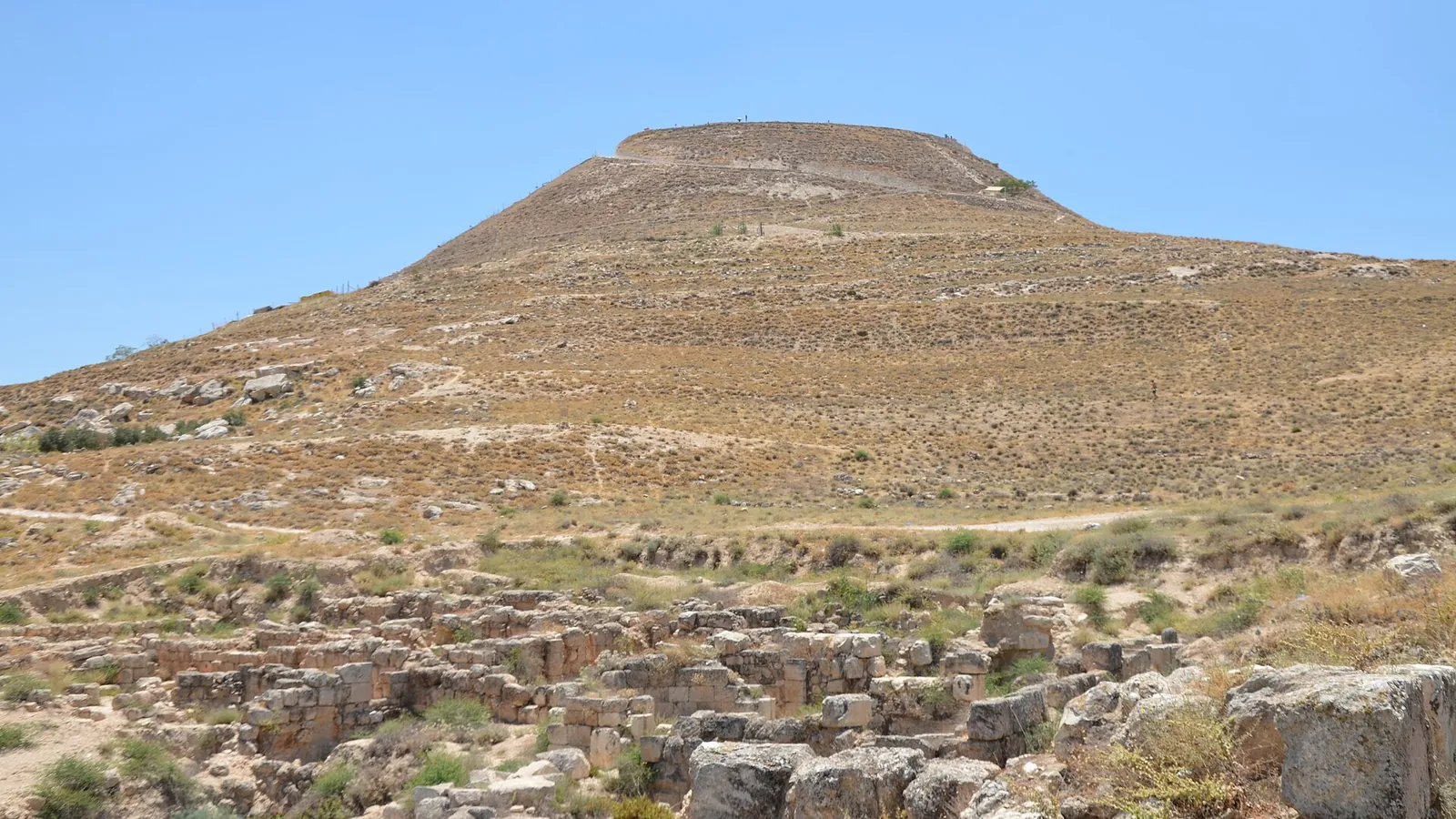
The conical hill of Herodium with the ruins of Herod's palace-fortress on top

Bethlehem Governorate, southeast of Bethlehem · Palestinian Territories

Herodium

A palace-fortress built by Herod the Great on top of an artificial cone of earth, with a tomb, hidden tunnels and views over the Judean Desert.

  • Best time March–May and September–November
  • Stay Half a day
  • Good for Archaeology, history, views, a half-day from Bethlehem

Photo: Carole Raddato from FRANKFURT, Germany · CC BY-SA 2.0

Welcome to Herodium

Herodium is one of the strangest and most striking ancient sites in the region. Around 23 BCE, Herod the Great, the Roman-appointed king of Judaea, chose a place south-east of Bethlehem, where he was believed to have won a battle, and built a palace-fortress on a hill. He had the summit raised into an artificial cone, about 60 metres high, with a circular wall and four towers, and built a second palace, a bathhouse, a theatre and a pool complex at the foot.

Herod died in 4 BCE, and according to the historian Josephus, he was buried here. In 2007, the Israeli archaeologist Ehud Netzer announced that he had found the tomb, on the slope of the hill, and the discovery was widely reported, although some scholars question the identification. The fortress was later used by Jewish rebels in the First Jewish Revolt and the Bar Kokhba Revolt, who dug tunnels and hiding places inside it, and by Byzantine monks who built a monastery.

The site lies in the West Bank, in Area C, under Israeli civil control, and it is run as a national park by the Israel Nature and Parks Authority. It is close to Israeli settlements, and the road links to Jerusalem are on the Israeli side, while visitors from Bethlehem can reach it by road. Palestinian and Israeli sources present its history and status differently, and it is a good place to bring an open mind.

  • Archaeology
  • Historic Site
  • Scenic Region

Why visit

Why visit Herodium?

Herodium is dramatic, easy to visit and full of stories, and it takes only half a day.

  • A palace on an artificial mountain

    The scale of the engineering is extraordinary, and the view from the top over the desert and the hills is superb.

  • Herod's tomb

    The claimed tomb, with its carved stone sarcophagus fragments, is one of the most talked-about discoveries of recent decades.

  • Underground tunnels

    Passages and cisterns beneath the fortress were dug by rebels and by Herod's engineers, and you can walk through them.

  • A landscape view

    From the rim, you can see the Judean Desert, the Dead Sea and, on a clear day, the mountains of Jordan.

  • Easy to combine

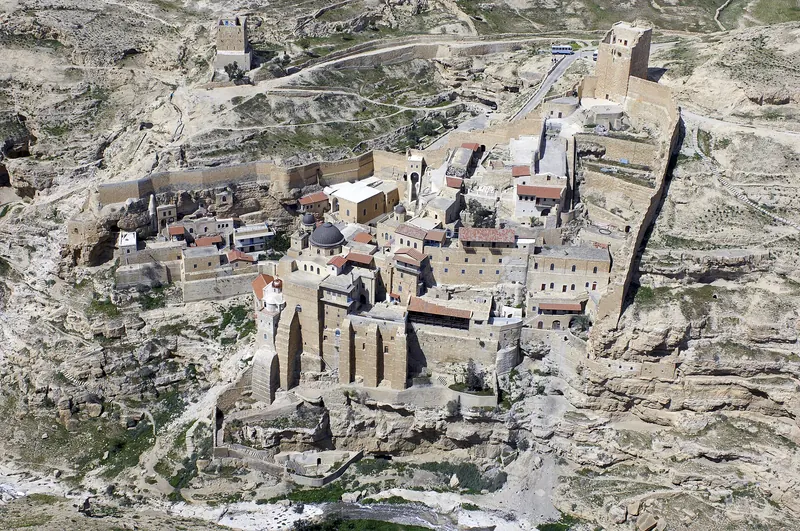
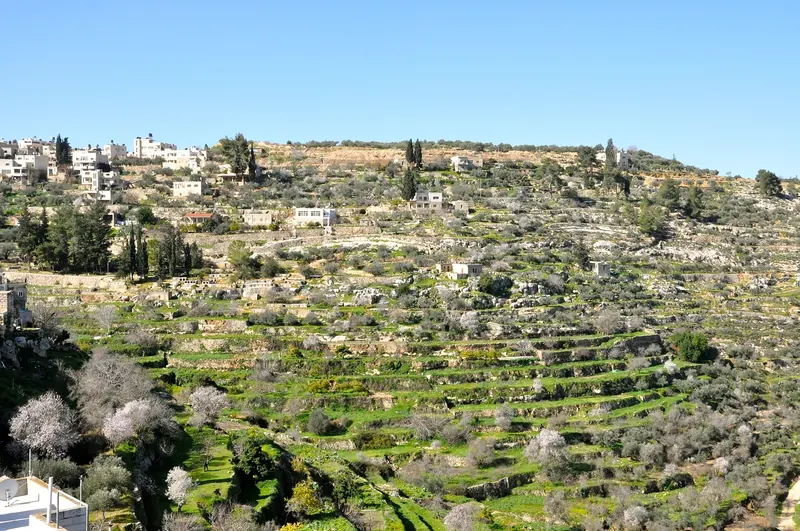
    It is close to Bethlehem, Battir and Mar Saba, and fits easily into a day with them.

Main attractions

Top things to see in Herodium

The site takes two to three hours, including the climb and the tunnels.

  1. The mountain palace and fortress

    The circular wall, the round towers and the remains of the palace's courtyard, bathhouse and dining rooms sit on the summit. Some are restored, and a museum has been built.

    Tip Go in the morning, when it is cooler and the light is good.

  2. The tunnels and cisterns

    Passages inside the hill, dug by Jewish rebels in the 1st and 2nd centuries CE, and underground cisterns that stored water for the palace.

    Tip Bring a torch, and watch your head. The tunnels are narrow.

  3. Herod's tomb

    A tomb on the hillside, excavated in 2007, that Ehud Netzer identified as the burial place of Herod. The ornate sarcophagus and fragments are displayed elsewhere.

    Tip The identification is disputed by some scholars.

  4. The Lower Herodium

    The remains of a huge complex at the foot of the hill, with a pool that was over 60 metres long, a palace, gardens and a monumental building.

    Tip Walk around the base to see the scale.

  5. The Herodium Museum and visitor centre

    A small museum on the site, displaying finds from the excavations and a model of the fortress.

    Tip See it before you climb.

  6. The Byzantine church and monastery

    Remains of a chapel and monastery built inside the fortress in the 5th century, showing later use of the site.

    Tip Look for the mosaic floor fragments.

Things to do

Best things to do in Herodium

Herodium is best enjoyed in a slow morning.

  1. Climb to the summit

    A path leads up the artificial hill to the fortress, with steep steps. The view over the desert is the reward.

    Tip Go early, take water and wear sturdy shoes.

  2. Walk through the tunnels

    Descend the steps into the hill, and walk through the narrow passages, cisterns and hiding places.

    Tip Not suitable for those who dislike enclosed spaces.

  3. See the view

    On a clear day you can see Jerusalem, the Dead Sea and the hills of Moab in Jordan.

    Tip Go in the late afternoon for the best light.

  4. Combine with Bethlehem and Mar Saba

    Herodium, Mar Saba and Bethlehem fit into a single day with a driver.

    Tip Start with the church, and finish at Herodium for the sunset.

  5. Explore the surrounding villages

    Villages such as Tuqu' and Beit Ta'mir have farms and small shops.

    Tip Ask your driver.

  6. Hear more than one story

    Palestinian, Israeli and international guides describe the site's history and status differently.

    Tip Ask about the perspective of your guide.

Local food

What to eat in Herodium

There is no restaurant on the site, so eat in Bethlehem or in a nearby village.

  • Picnic supplies

    Bring bread, hummus, fruit and olives from Bethlehem.

    Where to try it Shops in Bethlehem.

  • Bedouin hospitality

    Bedouin communities live in the hills nearby and sometimes offer tea and bread to visitors.

    Where to try it Ask your driver about a visit.

  • Falafel and hummus

    Available in Bethlehem and Beit Sahour.

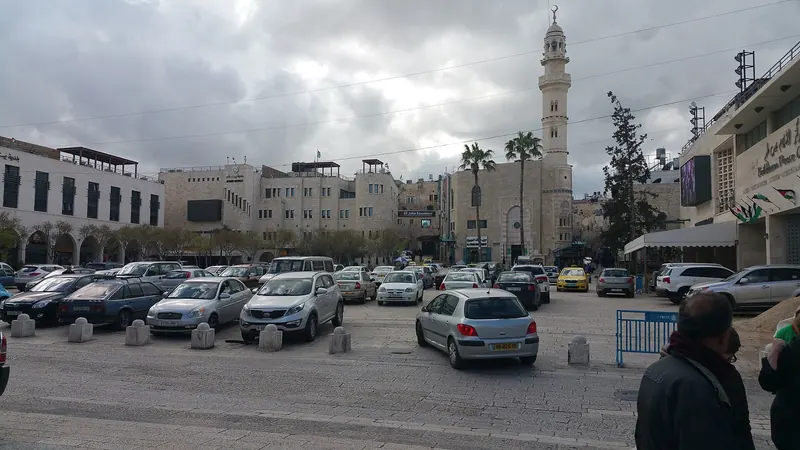
    Where to try it Stalls near Manger Square.

  • Village restaurants

    Small restaurants in nearby villages serve grilled meat and salads.

    Where to try it Ask your driver.

  • Fresh fruit

    Sold at roadside stalls in season.

    Where to try it Roadside stands.

  • Coffee and tea

    Served at the site's kiosk and in nearby villages.

    Where to try it The visitor centre.

Accommodation

Where to stay in Herodium

Most visitors base themselves in Bethlehem or Jerusalem and visit for the morning.

  • Bethlehem

    Hotels and guesthouses, and 15 minutes by road.

    Best for: Most visitors

  • Beit Sahour

    A pleasant town with guesthouses and restaurants close to Herodium.

    Best for: Quiet

What a night costs

Guesthouse in Bethlehem
₪150–300 per night
Mid-range hotel
₪350–600 per night
Site entry
About ₪30 per adult
Taxi from Bethlehem
₪60–120 round trip

Transport

Getting to and around Herodium

Herodium is about 5 km south-east of Bethlehem and 12 km from Jerusalem. Access routes depend on where you start.

Getting there

  • Taxi from Bethlehem

    About 15–20 minutes. Palestinian taxis take you to the site, and can wait or return.

    Agree the fare and waiting time.

  • Car from Jerusalem

    About 25 minutes via Israeli roads, though the route and checkpoints can change.

    Check your car rental terms before you go.

  • Tour

    Some operators include Herodium in tours of Bethlehem and the Judean Desert.

    Check what is included.

Getting around

The site is explored on foot, and the walk up to the fortress is steep.

  • Walking

    Paths lead up the hill and around the base. It takes two to three hours.

    Wear sturdy shoes.

  • Taxi

    Useful for moving between the site and nearby villages.

    Agree the fare.

  • Guided tour

    A guide brings the history to life.

    Book in advance.

When to go

Best time to visit Herodium

Herodium sits at about 750 m. Spring and autumn are the best seasons, and summer is hot with little shade.

  • Spring (March–May)

    Best time

    Green hills and clear views.

  • Summer (June–August)

    Shoulder

    Hot and exposed. Go early.

  • Autumn (September–November)

    Best time

    Warm, clear and quiet.

  • Winter (December–February)

    Quiet

    Cool, wet and windy at the top.

Worth planning around: Midday in summer, and days of unrest or road closures.

Itinerary

Half a day at Herodium

A morning climb, tunnels and the view, then lunch in Bethlehem.

  1. Day1

    Palace, tunnels and view

    A compact archaeological visit.

    • Morning The museum, then the climb to the fortress and the tunnels.
    • Afternoon The Lower Herodium, then lunch in Bethlehem.
    • Evening Return to Bethlehem or Jerusalem.

Travel tips

Herodium travel tips

Herodium is easy, and a few tips help.

  • Go early. There is little shade, and the light is best in the morning.
  • Bring water, a hat and sturdy shoes.
  • Take a torch for the tunnels.
  • Check who runs the site and the current entry arrangements. It is administered by the Israel Nature and Parks Authority.
  • Combine Herodium with Bethlehem or Mar Saba.
  • Check your car rental terms if you plan to drive.
  • Read about the site's history and status from more than one perspective.

FAQ

Herodium: frequently asked questions

Who built Herodium?

Herod the Great, the Roman client king of Judaea, around 23 BCE. He built a palace-fortress on an artificial hill, and, according to Josephus, was buried there.

Has Herod's tomb been found?

In 2007, the archaeologist Ehud Netzer announced that he had found it on the slope of the hill, but some scholars are not convinced by the identification.

Who runs Herodium?

It lies in the West Bank in Area C and is run as a national park by the Israel Nature and Parks Authority. The status of the site and the wider area is disputed.

How long do you need at Herodium?

Two to three hours, including the climb, the tunnels and the museum.

Can I visit Herodium from Bethlehem?

Yes. It is about 15–20 minutes by taxi, and many visitors combine it with the Church of the Nativity.

Is Herodium safe to visit?

It is generally regarded as safe in normal times, but it is in the West Bank near settlements and checkpoints, and conditions can change. Check your government's advice.

Read next

Related travel articles

Heritage

UNESCO Sites Worth Planning a Trip Around

A UNESCO listing tells you a place matters; it does not tell you whether it is worth two days and a detour. This is how to read the list usefully — and which sites reward building a trip around them.

Where to go

Beyond the Big Names: Places Worth the Detour

The most visited place in a country is rarely its best, and it is almost never its best value. This is a method for finding the destinations that do not make the postcards — and a set of examples from five of the 50 countries on this site.

Advertisement