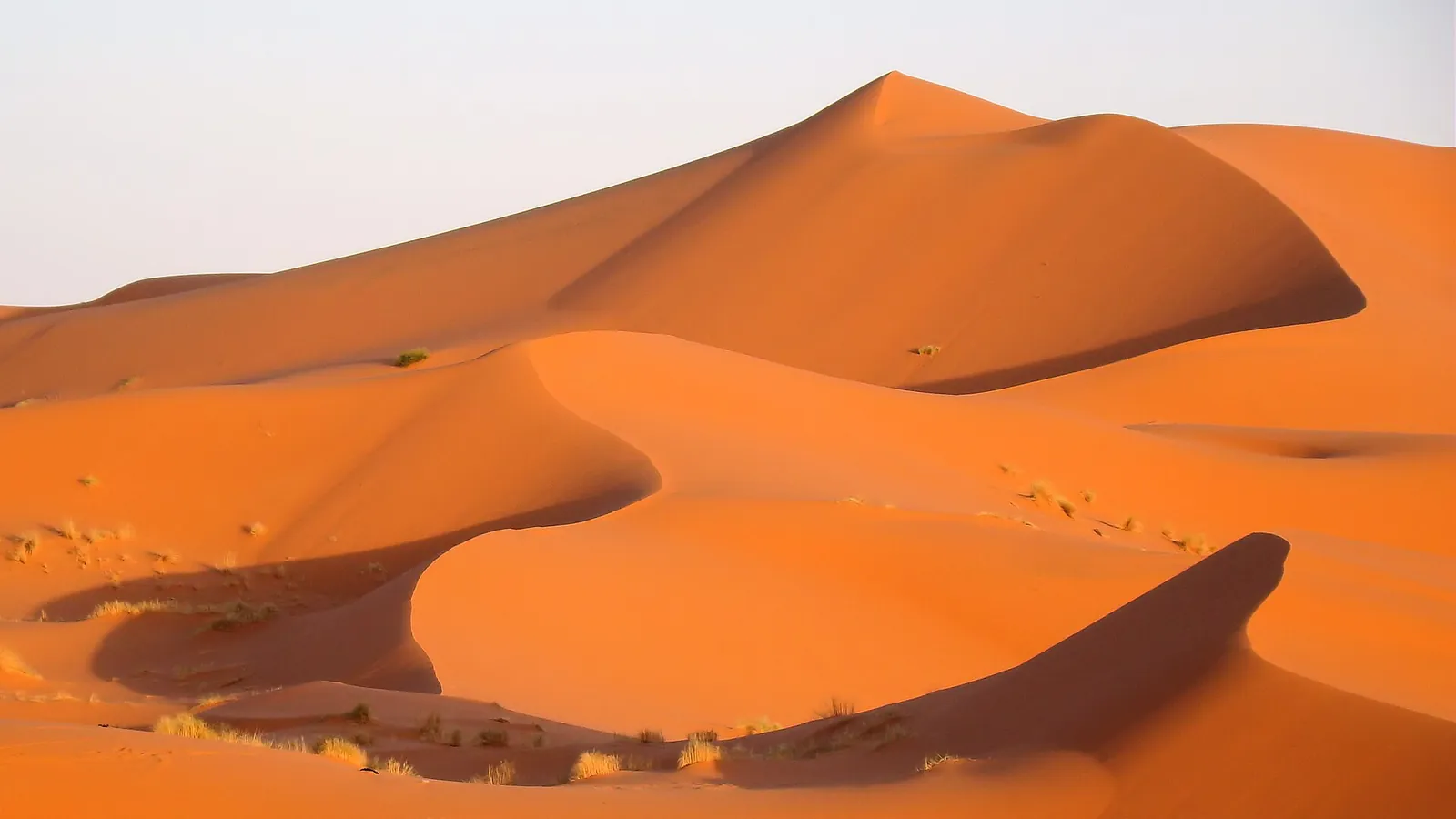
The orange sand dunes of Erg Chebbi near Merzouga in the Moroccan Sahara

Drâa-Tafilalet, south-east Morocco · Morocco

Merzouga and the Sahara

Golden dunes up to 150 metres high on the edge of the Sahara, reached by camel at dusk, with a night in a tented camp and a sunrise over the sand.

  • Best time October–April
  • Stay 2 days
  • Good for Desert landscapes, stargazing, adventure, photography

Photo: Bjørn Christian Tørrissen · CC BY-SA 3.0

Welcome to Merzouga

Merzouga is a small village at the edge of Erg Chebbi, a sea of sand about 22 km long and 5 km wide that rises to roughly 150 metres in places. It sits close to the Algerian border, in the far south-east of Morocco, about as far from Tangier as it is possible to be in the country. It is the most accessible large dune field in Morocco and the classic Saharan experience.

The tradition is to leave the village in the late afternoon on a camel, follow a Berber guide into the dunes and arrive at a tented camp as the sun goes down. The evening involves dinner, music and drumming around a fire, and clear skies with a great many stars. The next morning, climbing a dune to watch the sunrise is the reward.

The village and its surroundings also have a life of their own. Local Gnawa communities in Khamlia perform music descended from West African traditions, Rissani has a busy market and the tombs of the Alaouite dynasty's ancestors, and nomads still camp near the dunes.

  • Nature & Wildlife
  • Scenic Region
  • Off the Beaten Path

Why visit

Why visit Merzouga?

Merzouga gives a memorable night in the Sahara without requiring days of trekking.

  • Real dunes

    Erg Chebbi is a proper sand sea, with towering, ever-shifting dunes and sweeping curves.

  • The camel trek

    A slow ride into the dunes at dusk is one of the most iconic experiences in Morocco.

  • Sunrise and stars

    With little light pollution, the night sky is spectacular, and dawn on the dunes is memorable.

  • Local music and culture

    Gnawa musicians, Amazigh hospitality and the desert markets at Rissani.

  • Adventure options

    Sandboarding, 4x4 excursions and walking in the dunes.

Main attractions

Top things to see in Merzouga

The main event is the dunes, and the surroundings add variety over a couple of days.

  1. Erg Chebbi

    The sea of dunes, which reaches its greatest height near the Merzouga side. The sand is fine and orange, turning red at sunset.

    Tip Climb the highest dune for sunrise, and bring a scarf against the wind.

  2. A desert camp

    A camp of tents in the dunes, from simple Berber tents to luxury tents with private bathrooms. Dinner and music are included.

    Tip Check whether winter tents are heated, and whether the camp is on the dunes or at the edge.

  3. Khamlia village

    A village of Gnawa people, descended from sub-Saharan Africans, who perform trance music and drumming.

    Tip Give a fair tip to the musicians.

  4. Rissani

    The historic market town, the ancestral home of the Alaouite dynasty and site of the ancient trading city of Sijilmassa, with a lively souk on market days.

    Tip Go on a Tuesday, Thursday or Sunday for the main market.

  5. Dayet Srji (the seasonal lake)

    A seasonal lake by the dunes that fills after heavy rain and attracts flamingos and other birds.

    Tip Ask locally whether it has water.

Things to do

Best things to do in Merzouga

A camel trek and a night in the dunes are the main thing, with a few extras.

  1. Ride a camel at sunset

    About an hour and a half's ride into the dunes, guided by a local.

    Tip Wear long trousers and a scarf.

  2. Sleep in a camp

    Dinner, drums and stars, then breakfast at dawn.

    Tip Bring a torch and warm layers.

  3. Watch the sunrise from a dune

    Climb up before dawn and watch the sand change colour.

    Tip The climb takes about 30 minutes.

  4. Try sandboarding

    Sledding down the dunes on a board, an easy family activity.

    Tip Boards are provided by camps.

  5. Take a 4x4 tour

    A drive through the desert hamlets, the lake and the Gnawa village.

    Tip Book with a reputable operator, and consider the environmental impact of quad bikes.

  6. Stargaze

    On a clear night, the Milky Way is visible without effort.

    Tip Avoid nights with a full moon.

Local food

What to eat in Merzouga

Desert food is simple and hearty, based on bread, meat and vegetables.

  • Berber pizza (madfouna)

    A folded bread stuffed with meat, onions and spices and baked in the sand.

    Where to try it Local restaurants in Rissani and Merzouga.

  • Tagine

    The staple, cooked with lamb, chicken or vegetables.

    Where to try it Camps and hotels.

  • Dates

    Sweet dates from the nearby oases.

    Where to try it Markets.

  • Mint tea

    The universal welcome, drunk in the dunes.

    Where to try it Camps.

  • Couscous

    Served on Fridays and for special occasions.

    Where to try it Local restaurants.

Accommodation

Where to stay in Merzouga

Most visitors stay one night in the desert and a night in a hotel or kasbah in Merzouga.

  • A desert camp

    Basic Berber tents or luxury tents deep in the dunes.

    Best for: The dune experience

  • Merzouga village

    Kasbah-style hotels with pools at the foot of the dunes.

    Best for: Comfort and views

What a night costs

Basic camp
US$40–80 per person, with dinner and breakfast
Mid-range camp
US$80–150 per person
Luxury tent
US$200–500 per person
Meal at a local restaurant
US$5–12 per person

Transport

Getting to and around Merzouga

Merzouga is remote. The drive is part of the experience.

Getting there

  • Drive from Fes

    About 9 hours by road through the Middle Atlas and the Ziz Valley.

    Break the journey at Midelt.

  • Drive from Marrakech

    About 9 hours via Ouarzazate and the Dadès and Todra gorges, ideally over two days.

    A driver is recommended.

  • Organised tour

    Multi-day tours from Fes and Marrakech include the desert night.

    Check group size and what is included.

  • Bus or flight

    Buses run to Erfoud and Rissani, and Errachidia airport has limited flights.

    Last miles by taxi.

Getting around

Within Merzouga, everything is arranged by your camp or hotel.

  • Camel

    The classic way to reach a camp.

    Included in most camp packages.

  • 4x4

    Used for excursions and to reach remote camps.

    Book with your hotel.

  • On foot

    Walking in the dunes is possible, but keep to marked tracks and go with someone.

    Take water.

When to go

Best time to visit Merzouga

The Sahara is scorching in summer and cold at night in winter. Spring and autumn are best.

  • Spring (March–May)

    Best time

    Warm days, cool nights and clear skies. Sandstorms are possible.

  • Summer (June–August)

    Think twice

    Extremely hot, often above 40°C.

  • Autumn (September–November)

    Best time

    Hot in September, then pleasant from October.

  • Winter (December–February)

    Good

    Pleasant days but cold nights, near freezing.

Worth planning around: June to August, when the desert heat is extreme.

Itinerary

Two days in the Sahara

A night in the dunes and a morning to enjoy the surroundings.

  1. Day1

    Arrive and ride into the dunes

    Camels and camp.

    • Morning Arrive at Merzouga.
    • Afternoon A camel ride to the camp at sunset.
    • Evening Dinner, drums and stars.
  2. Day2

    Sunrise and the surroundings

    Dunes and villages.

    • Morning Sunrise from the dunes, and breakfast.
    • Afternoon Khamlia and Rissani.
    • Evening A rest or an onward drive.

Travel tips

Merzouga travel tips

A few things prepare you for the desert.

  • Do not plan Merzouga as a day trip. The desert experience needs a night.
  • Pack layers. Nights are cold in winter, even after a hot day.
  • Bring a scarf for the sun, wind and sand, and sunglasses.
  • Take a small bag for the camel ride. Larger luggage stays in the hotel.
  • Read reviews of camps and check that tents are private.
  • Drink plenty of water.
  • Take cash for tips and small purchases.

FAQ

Merzouga: frequently asked questions

How long do you need in Merzouga?

At least one night in the dunes, with arrival the previous evening or a full day to reach it.

Is it worth the long drive?

For most visitors, yes. The dunes are a highlight. If time is short, the Agafay Desert near Marrakech is a stony alternative.

Is the desert safe?

The main tourist area is well organised. Go with a reputable guide, and avoid the border area.

What should I wear?

Comfortable long clothes, a scarf, sturdy shoes and warm layers for the evening.

Are camel rides ethical?

Conditions vary. Choose operators who look after their animals, and ask about their care.

Can I see the desert without a camel?

Yes, by 4x4 or on foot, though the camel is the traditional way.

Read next

Related travel articles

Practical

Packing by Season and Trip Type

Most packing advice is a list of things. This is the opposite: the small number of decisions that determine whether your luggage helps or hinders, organised by the kind of trip you are actually taking.

Where to go

Beyond the Big Names: Places Worth the Detour

The most visited place in a country is rarely its best, and it is almost never its best value. This is a method for finding the destinations that do not make the postcards — and a set of examples from five of the 50 countries on this site.

Advertisement