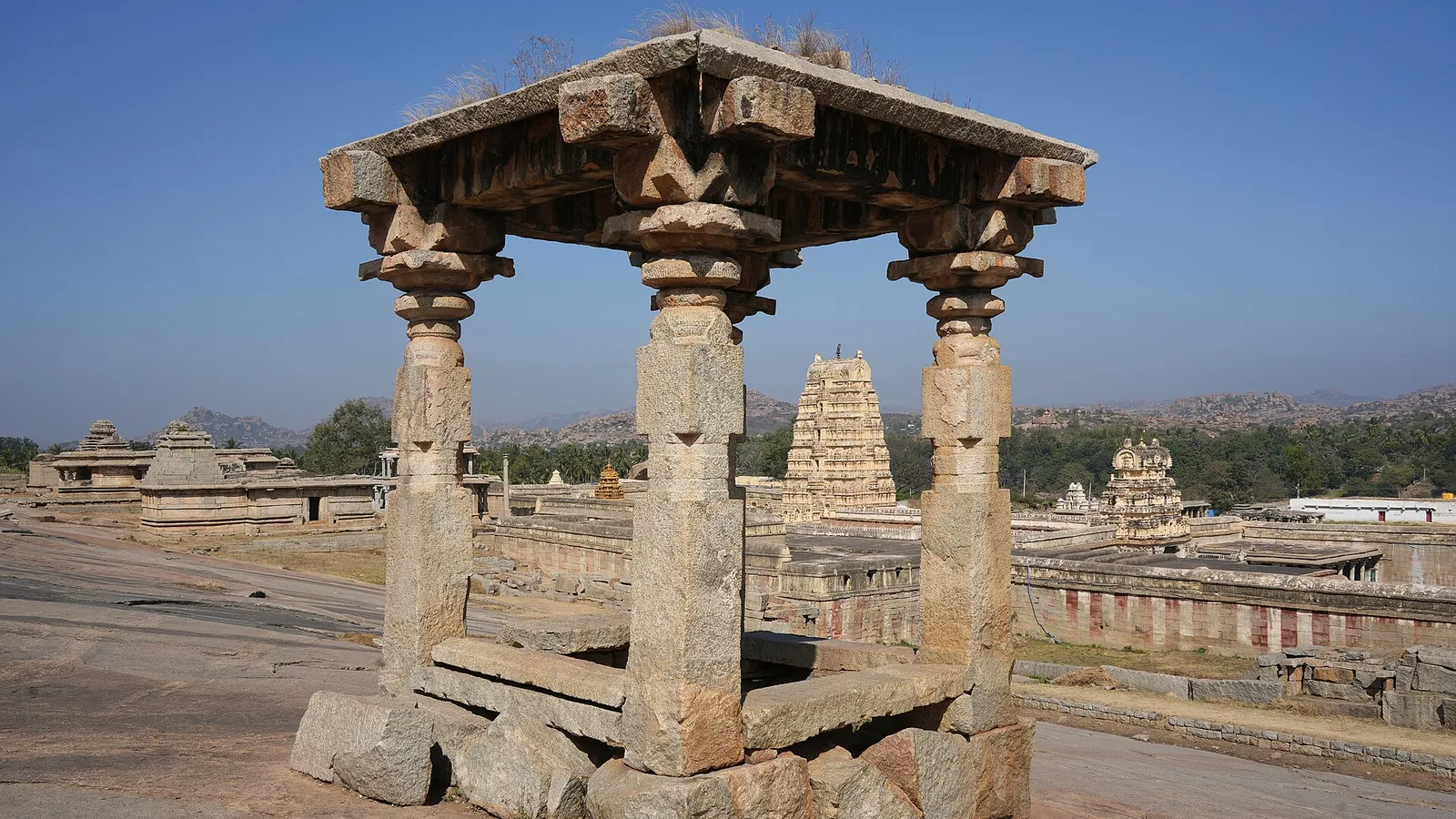
The gopuram of the Virupaksha Temple rising among boulders on Hemakuta Hill in Hampi

Karnataka, southern India · India

Hampi

The ruined capital of the Vijayanagara Empire, scattered among giant granite boulders, banana fields and a river: temples, bazaars and royal enclosures in a surreal landscape.

  • Best time October–February
  • Stay 2–3 days
  • Good for Archaeology, cycling, sunsets, quiet exploration, a gentle pace

Photo: Ingo Mehling · CC BY-SA 4.0

Welcome to Hampi

Hampi was the capital of the Vijayanagara Empire, the great Hindu kingdom that dominated southern India from the 14th to the 16th century. At its height, in the early 1500s, its capital was one of the largest cities in the world, with markets full of pearls and diamonds, according to foreign visitors. In 1565 the armies of the Deccan sultanates defeated the empire at the Battle of Talikota, and Hampi was sacked and abandoned over several months.

The ruins spread across some 25 square kilometres of a landscape of huge granite boulders, banana and rice fields and the Tungabhadra river. The site holds temples, royal enclosures, water tanks, elephant stables, stepwells and market streets, more than 1,600 monuments in all. UNESCO listed it in 1986. Unlike most ruined cities, one part, the Virupaksha Temple, is still a place of worship, and the village of Hampi Bazaar has tea shops and guesthouses among the old stones.

Hampi is one of the most atmospheric places in India, and a favourite of backpackers and photographers. It is best explored slowly, by bicycle or scooter, with time for sunrise and sunset viewpoints. It is also relatively free of the hassle that comes with the Golden Triangle, and a good place to slow down.

  • UNESCO Site
  • Archaeology
  • Historic Site
  • Scenic Region

Why visit

Why visit Hampi?

Hampi is a unique combination of archaeology and landscape, and one of the great historical sites of India.

  • A vanished empire

    Temples, palaces and markets of a city that was among the richest in the world.

  • A strange landscape

    Enormous boulders piled on hills, and lush green fields between them.

  • Exceptional sculpture

    The stone chariot and the musical pillars at Vittala Temple are outstanding.

  • A living temple

    The Virupaksha Temple is still in daily use, with pilgrims, priests and daily rituals.

  • Slow travel

    Cycling, coracle rides and sunset viewpoints suit the pace.

Main attractions

Top things to see in Hampi

The monuments fall into two areas: the sacred centre around Hampi Bazaar and the royal centre to the south. Give each half a day.

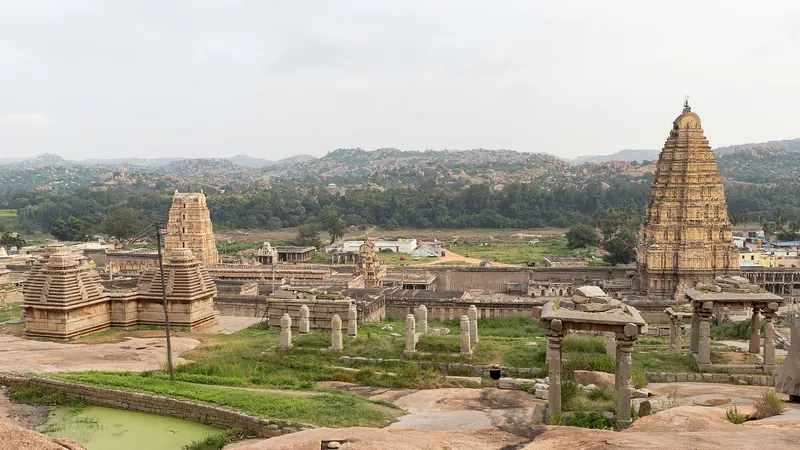
  1. The gateway tower of the Virupaksha Temple complex in Hampi

    The Virupaksha Temple

    A temple to Shiva dating from at least the 7th century, and still active, with a towering gateway at the end of the main bazaar street. It survived the sack of the city.

    Tip Go in the morning, when the rituals are under way.

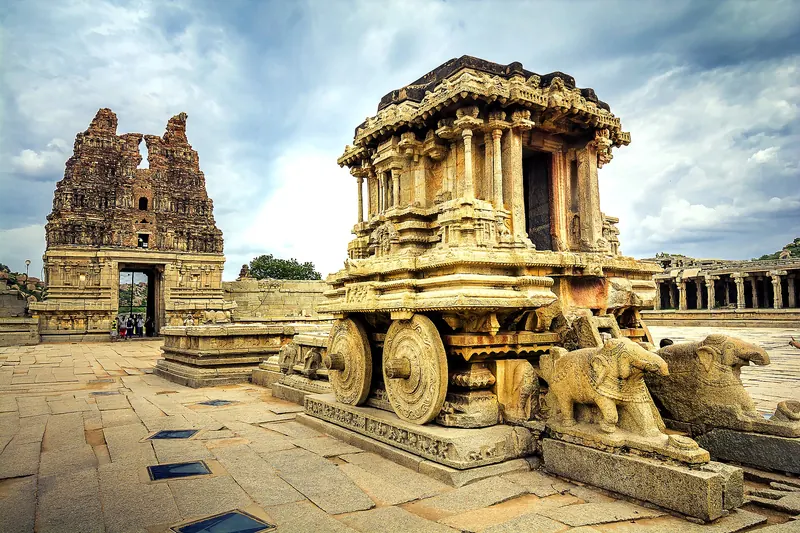
  2. The stone chariot shrine in the courtyard of the Vittala Temple at Hampi

    The Vittala Temple

    The masterpiece of Vijayanagara architecture, with an ornately carved stone chariot in its courtyard and a hall of pillars that once produced musical notes when tapped. Tapping is now prohibited to protect them.

    Tip Go early, and note that entry is ticketed.

  3. The Royal Enclosure

    The palace precinct in the south, with the Lotus Mahal, the elephant stables, the Queen's Bath and the great platform of the Mahanavami Dibba.

    Tip A combined ticket covers several sites.

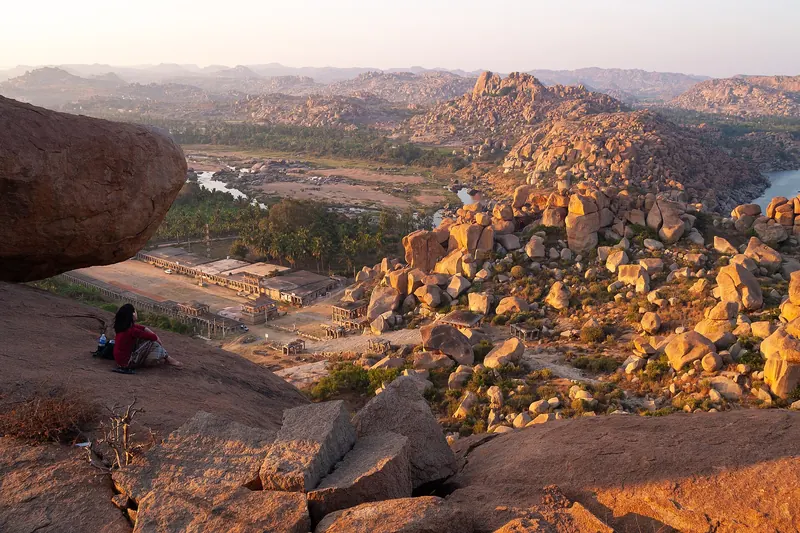
  4. The rocky landscape of Hampi seen from Matanga Hill with granite boulders and green fields

    Matanga Hill

    The highest hill in the area, about 20 minutes to climb, with a panorama of the ruins and river at sunrise.

    Tip Bring a torch for the climb in the dark.

  5. Hemakuta Hill

    A hill near the Virupaksha Temple with early Jain and Shiva shrines, and one of the best sunset spots.

    Tip Go at sunset.

  6. Anegundi and the Tungabhadra

    The village across the river, reached by coracle boat, with older ruins, a hilltop Hanuman temple and quiet rural scenery.

    Tip Cross by coracle, and take a bicycle.

Things to do

Best things to do in Hampi

Hampi is best explored slowly, on two wheels or on foot.

  1. Cycle among the ruins

    Bicycles are the ideal way to move between the monuments, and can be rented in the village.

    Tip Start early, and carry water.

  2. Watch sunrise from Matanga Hill

    Climb the hill before dawn for a view over the ruins and river.

    Tip Go with a torch.

  3. Ride a coracle

    Round wicker boats, covered in leather or plastic, ferry people across the river.

    Tip Agree the price.

  4. Try bouldering at Hampi Island

    The boulders across the river are famous for rock climbing.

    Tip Go with an experienced local guide.

  5. Visit the Archaeological Museum

    A small museum at Kamalapura that gives useful context to the site.

    Tip Go before the ruins.

  6. Relax in a riverside café

    Hampi's cafés serve simple food with views of the temples.

    Tip Try the local thali.

Local food

What to eat in Hampi

Hampi's food is simple South Indian and traveller fare. The area near the temple is largely vegetarian.

  • South Indian breakfast

    Idli, dosa and vada with sambar and chutney.

    Where to try it Local cafés.

  • Thali

    A rice and curry meal served on a banana leaf or metal plate.

    Where to try it Restaurants in Hampi Bazaar.

  • North Karnataka meals

    Jolada rotti (sorghum bread) with spicy curries.

    Where to try it Local restaurants in Hospet.

  • Fresh fruit

    Bananas from the local fields, sold everywhere.

    Where to try it Stalls.

  • Chai and lassi

    Refreshments at tea stalls.

    Where to try it Hampi Bazaar.

Accommodation

Where to stay in Hampi

Choose between the atmosphere of Hampi village, the peace of the river's north bank, and the comforts of Hospet.

  • Hampi Bazaar

    Simple guesthouses and cafés.

    Best for: Walking distance to the temple

  • Virupapur Gadde (Hampi Island)

    Guesthouses and cafés across the river.

    Best for: A relaxed, traveller scene

  • Hospet and Kamalapura

    Mid-range hotels, 13 km away.

    Best for: Comfort and transport

What a night costs

Budget guesthouse
US$10–30 per night
Mid-range hotel
US$40–90 per night
Heritage resort
US$120–250 per night
Meal at a local café
US$2–8 per person

Transport

Getting to and around Hampi

Hampi is about 350 km from Bengaluru and 260 km from Goa.

Getting there

  • Train to Hospet

    An overnight train from Bengaluru takes about 7 to 9 hours to Hospet, 13 km from Hampi.

    Book early.

  • Bus or road

    Overnight buses from Bengaluru and Goa, and a 6 to 8 hour drive from Goa.

    Roads can be slow.

  • Flight

    Limited flights to Vidyanagar (VDY), or fly to Hubballi or Bengaluru.

    Check schedules.

Getting around

The site is spread out, and the best ways to see it are by bicycle or scooter.

  • Bicycle

    The best way to explore, at a low price.

    Start early in the day.

  • Auto-rickshaw

    A day hire covers the main monuments.

    Agree the price.

  • Scooter

    Popular for the wider area.

    Wear a helmet.

When to go

Best time to visit Hampi

Hampi is hot and dry for much of the year, and the rocky landscape amplifies the heat.

  • Winter (November–February)

    Best time

    Warm, dry and pleasant. Peak season.

  • Spring (March–May)

    Think twice

    Very hot.

  • Monsoon (June–September)

    Quiet

    The landscape is green, rain is moderate, and there are few visitors.

  • Post-monsoon (October)

    Good

    Green and warm.

Worth planning around: March to May. The Hampi Utsav in winter brings crowds.

Itinerary

Three days in Hampi

The sacred centre, the royal enclosure and the far bank.

  1. Day1

    The sacred centre

    Temples and the bazaar.

    • Morning The Virupaksha Temple.
    • Afternoon Hampi Bazaar and Hemakuta Hill.
    • Evening Sunset on Hemakuta Hill.
  2. Day2

    The royal centre

    Palaces and stones.

    • Morning The Vittala Temple and its stone chariot.
    • Afternoon The Royal Enclosure and the Lotus Mahal.
    • Evening A café by the river.
  3. Day3

    Across the river

    A quiet day.

    • Morning Sunrise from Matanga Hill.
    • Afternoon Anegundi by coracle and bicycle.
    • Evening Depart.

Travel tips

Hampi travel tips

A few tips help you make the most of the site.

  • Start early, since the sun is intense and the site is shadeless.
  • Hire a bicycle, and carry water.
  • Get a local guide for context, since there are few signs.
  • Dress modestly at temples.
  • Keep to marked paths, and watch for monkeys.
  • Book accommodation ahead for Hampi Utsav.
  • Note that alcohol and meat are restricted in the temple area.

FAQ

Hampi: frequently asked questions

How many days do you need in Hampi?

Two days for the highlights, three if you want to explore slowly.

What is the best way to see Hampi?

By bicycle or scooter, starting early, with a local guide for context.

Is Hampi worth visiting?

Yes. It is one of the most remarkable historic sites in India, and quieter than the north.

What is the best time to visit?

November to February. Summer is extremely hot.

Can I combine Hampi with Goa?

Yes. It is about 6 to 8 hours by road, or by overnight train and bus.

Why was Hampi abandoned?

After the Battle of Talikota in 1565, the city was captured and sacked, and it was never rebuilt as a capital.

Read next

Related travel articles

Heritage

UNESCO Sites Worth Planning a Trip Around

A UNESCO listing tells you a place matters; it does not tell you whether it is worth two days and a detour. This is how to read the list usefully — and which sites reward building a trip around them.

Where to go

Beyond the Big Names: Places Worth the Detour

The most visited place in a country is rarely its best, and it is almost never its best value. This is a method for finding the destinations that do not make the postcards — and a set of examples from five of the 50 countries on this site.

Advertisement