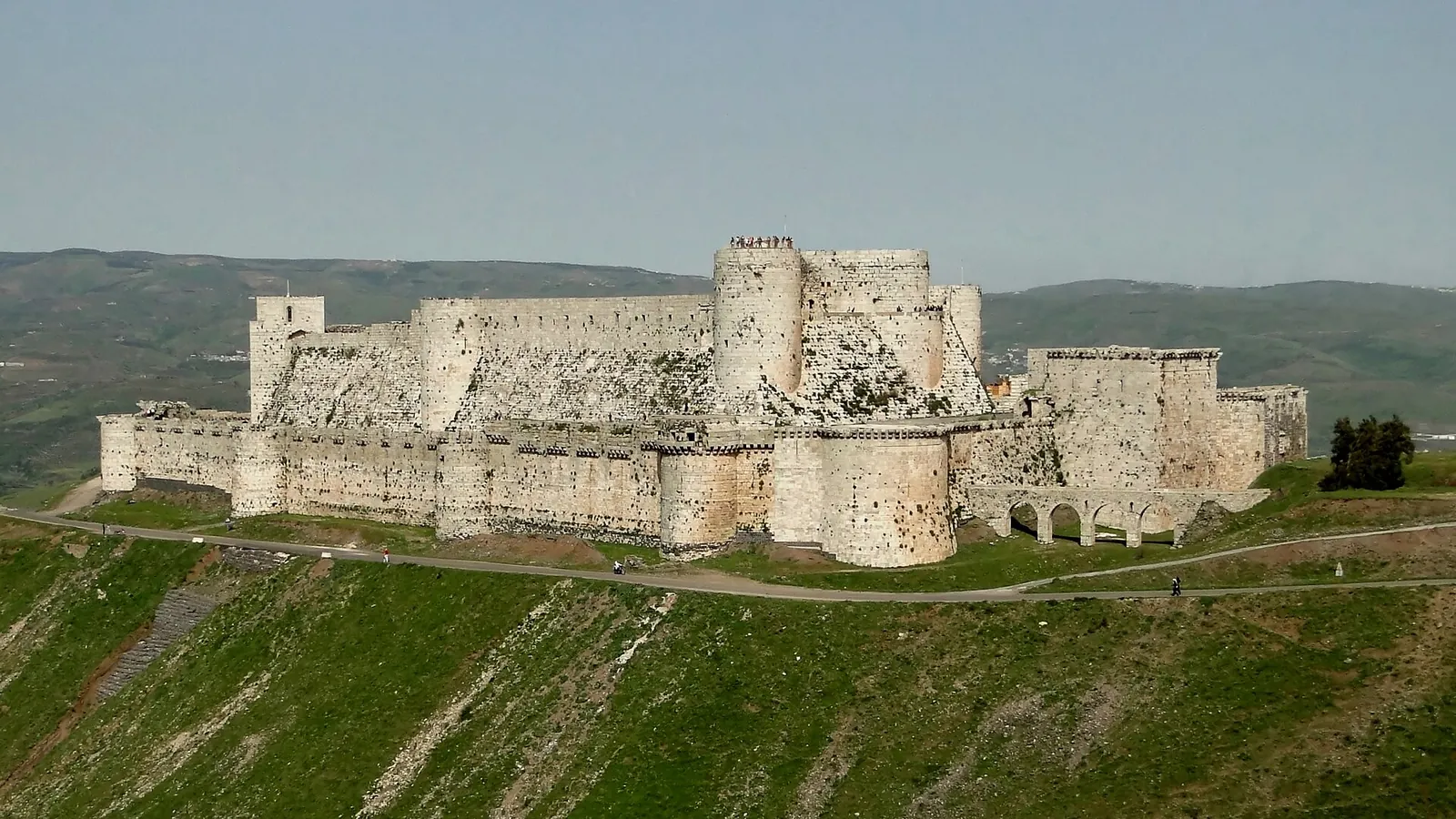
The walls and towers of Krak des Chevaliers on its hilltop, photographed in 2010, before the war

Homs Governorate, western Syria · Syria

Krak des Chevaliers

A Crusader castle on a hilltop above the Homs Gap, one of the best-preserved medieval fortresses in the world and, in T. E. Lawrence's words, 'the best preserved and most wholly admirable castle in the world'.

  • Site status Damaged, largely standing
  • Known for Concentric walls, the great hall, Hospitaller history, medieval military architecture

Photo: Bernard Gagnon · CC BY-SA 4.0

Welcome to Krak des Chevaliers

Krak des Chevaliers stands on a spur of the Jebel Ansariyah at about 650 metres, above the Homs Gap, the natural route between the Syrian interior and the Mediterranean coast. The site was fortified before the Crusades, and in 1142 Raymond II, Count of Tripoli, gave it to the Knights Hospitaller, the military order that had begun as a hospital for pilgrims in Jerusalem. Over the following 130 years, the Hospitallers rebuilt and expanded it into one of the greatest castles of the Middle Ages.

The result was a concentric fortress: an inner ward with massive towers, a great hall, a chapel and a cloister, surrounded by a second outer wall with a water-filled moat, a sloping glacis and a long entrance passage designed to slow attackers. It could house up to 2,000 soldiers and withstood many sieges. It finally fell to the Mamluk sultan Baibars in 1271, reportedly after he tricked the garrison with a forged letter ordering their surrender.

The fortress was later used by the Mamluks and the Ottomans, and a village grew inside it until the 1930s, when the French authorities moved the villagers out and restored the castle. It was inscribed on the UNESCO World Heritage List in 2006, together with Saladin's Castle. It was damaged in the war and its condition is reported to be improving, but the region remains subject to warnings. This page describes the history, and is not a guide to visiting.

  • UNESCO Site
  • Historic Site
  • Mountains

Why it matters

Why Krak des Chevaliers matters

Krak des Chevaliers matters because it shows how a medieval castle was designed, and because it survived so much better than almost any other.

  • Concentric defences

    Two rings of walls, with the inner ward higher than the outer, allowed defenders to fire over the lower wall, and the elaborate entrance, with its bends and vaulted passages, was a model of defensive design.

  • A near-complete castle

    Most of the fortress's rooms, towers and halls survive, including a Gothic great hall, a loggia, a chapel and vast storerooms, kitchens and stables.

  • A view over the landscape

    The castle overlooks the Homs Gap, the Orontes valley and, on clear days, the Mediterranean and the Lebanese mountains.

  • The story of the Hospitallers

    The order, which began caring for pilgrims and became a military power, shaped the history of the Crusader states, and later the history of Rhodes and Malta.

  • A symbol of Syria's medieval heritage

    Together with Saladin's Castle, it shows how Crusaders, Ayyubids and Mamluks built, fought over and reused the same fortresses.

Main attractions

Key sites and monuments in Krak des Chevaliers

The following are the main features of the castle as it was documented before the war. It is not a visitor route.

  1. The entrance ramp and gate

    A long, vaulted ramp climbs from the outer gate into the inner ward, with several turns, a portcullis and murder holes that made it very hard for attackers to force.

  2. The outer wall, moat and glacis

    The outer curtain wall, rebuilt in the 13th century, with round towers, a wide moat that held a reservoir and a steep sloping glacis that made undermining the walls almost impossible.

  3. The great hall and loggia

    A Gothic vaulted hall and a long loggia of pointed arches overlooking the inner courtyard. It was the ceremonial centre of the castle, and its architecture is closely related to that of French Gothic churches.

  4. The chapel

    A 12th-century chapel in the inner ward, later converted into a mosque by the Mamluks, with a pulpit that was added in the 13th century.

  5. The southern towers

    Three huge round towers on the southern side, the most vulnerable point, which held the Grand Master's quarters and formed the castle's keep. Mamluk inscriptions record the repairs made after 1271.

  6. Storerooms, stables and cisterns

    The vast vaulted stables, which could hold about a thousand horses, and the storerooms and cisterns, which allowed the garrison to survive a long siege.

Condition and access

Krak des Chevaliers today

Krak des Chevaliers was occupied by opposition fighters and shelled in 2012–2014. It was recaptured by the government in March 2014, and its condition is reported to be improving, though information is limited.

  • Damage during the war

    Opposition fighters used the castle as a base from 2012, and it was hit by shelling and airstrikes in 2013 and 2014. UNESCO reported damage to the towers, the walls, the great hall and the chapel, including the collapse of parts of the outer walls.

  • Looting

    Some looting of the site and the nearby village was reported. The castle's architecture is so substantial that most of the structure survived.

  • Recapture and repair

    After the government retook the castle in March 2014, the Syrian antiquities authorities began repair and consolidation work, with support from UNESCO and other organisations.

  • World Heritage status

    Together with Saladin's Castle, it has been on the List of World Heritage in Danger since 2013, and monitoring continues.

  • Advice

    Most governments advised against travel to Syria, including this region, at the time of writing. Check your government's current advice. This page is not a recommendation to go.

FAQ

Krak des Chevaliers: frequently asked questions

Who built Krak des Chevaliers?

The Knights Hospitaller, a Crusader military order, who acquired the site in 1142 and rebuilt it in the 12th and 13th centuries. Earlier fortifications had existed on the hill since the 11th century.

What does 'Krak' mean?

It comes from the Syriac and Arabic word for a fortress, and was applied to several castles in the Crusader states. 'Des Chevaliers' means 'of the Knights'.

How did the castle fall?

The Mamluk sultan Baibars besieged it in 1271 and, after breaching the outer wall, reportedly tricked the garrison into surrendering with a forged letter from the Hospitaller commander in Tripoli.

How badly was it damaged in the war?

The castle was shelled and bombed in 2013 and 2014 and suffered damage to walls and towers, but most of the structure survived. Repair work began after 2014.

Is it safe to visit Krak des Chevaliers?

Most governments advised against all travel to Syria at the time of writing, and conditions vary by area. This site does not recommend travel. Check your government's current advice.

What other castles are similar?

Saladin's Castle in Syria, Belvoir and Montfort in Israel, Kerak and Shobak in Jordan, and Marqab on the Syrian coast are all Crusader-era fortresses with related design and history.

Read next

Related travel articles

Heritage

UNESCO Sites Worth Planning a Trip Around

A UNESCO listing tells you a place matters; it does not tell you whether it is worth two days and a detour. This is how to read the list usefully — and which sites reward building a trip around them.

Where to go

Beyond the Big Names: Places Worth the Detour

The most visited place in a country is rarely its best, and it is almost never its best value. This is a method for finding the destinations that do not make the postcards — and a set of examples from five of the 50 countries on this site.

Advertisement