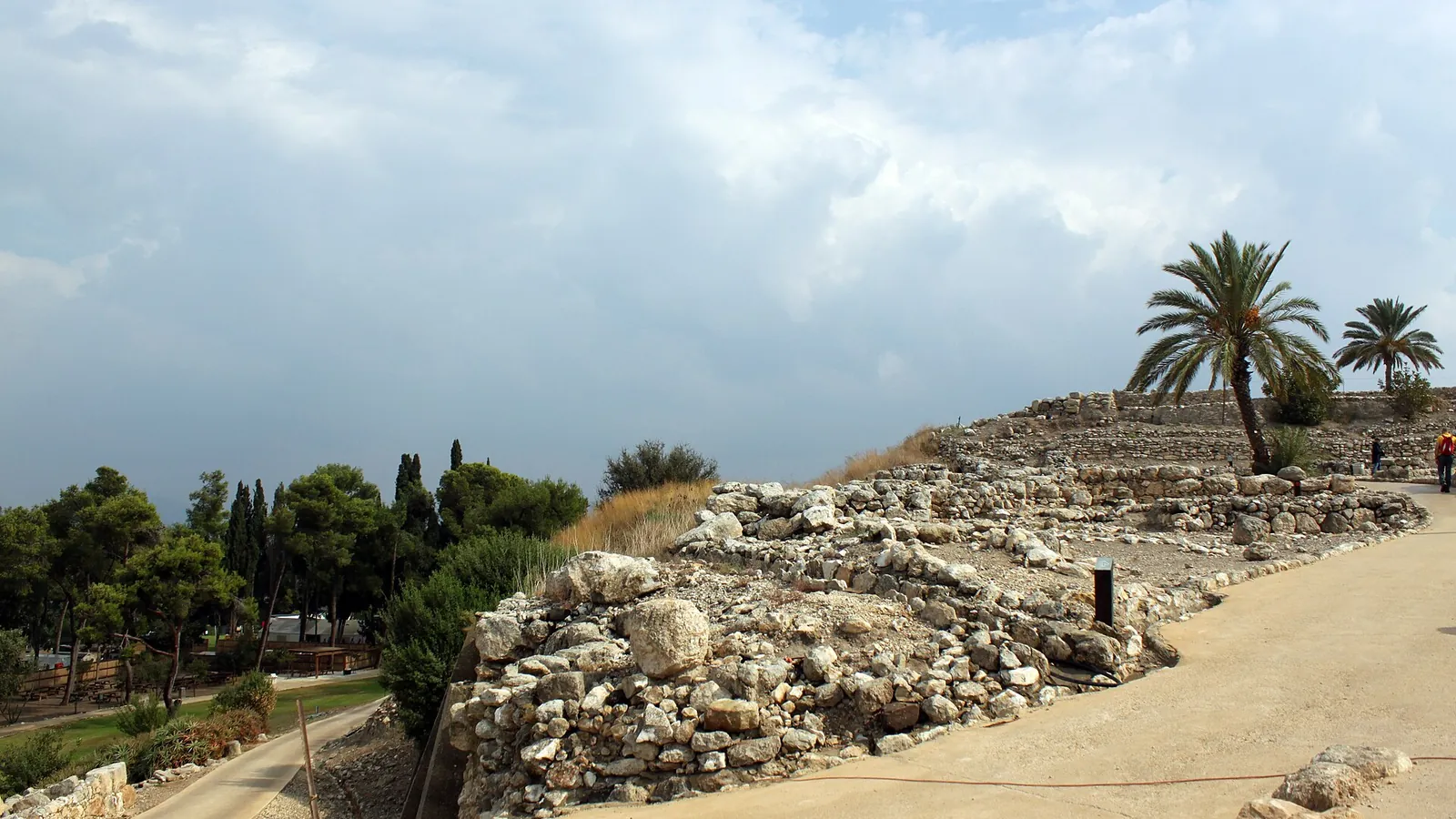
The excavated ruins on top of Tel Megiddo overlooking the Jezreel Valley

Northern District, Jezreel and Beit She'an valleys · Israel

Megiddo & Beit She'an

A hill of twenty-six buried cities that gave the word Armageddon its name, and a Roman-Byzantine city with a colonnaded street and a 7,000-seat theatre.

  • Best time March–May and October–November
  • Stay 1 day
  • Good for Archaeology, biblical and Roman history, off-the-beaten-path travel

Photo: Anagoria · CC BY 3.0

Welcome to Megiddo and Beit She'an

Tel Megiddo is a mound about 60 metres high that overlooks the Jezreel Valley, on the ancient route between Egypt and Mesopotamia. Over some five thousand years, twenty-six successive cities were built on the same spot, each on the ruins of the last, and archaeologists have peeled back the layers to reveal palaces, temples, stables, gates and a remarkable underground water system. It was listed by UNESCO in 2005, with two other sites, as a biblical tell.

Megiddo is also the origin of the word 'Armageddon', from the Hebrew Har Megiddo, 'Mount Megiddo', which appears in the Book of Revelation as the site of a final battle. Its position at a strategic crossroads meant that many real battles were fought here, from the Egyptian victory of Thutmose III in about 1457 BCE to the British campaign of 1918.

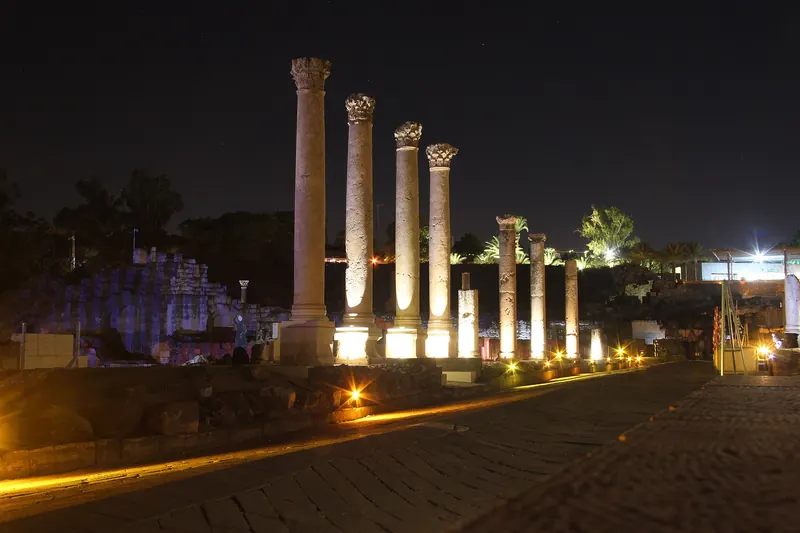
Half an hour to the east lies Beit She'an, ancient Scythopolis, the only Decapolis city west of the Jordan. It was one of the largest and richest cities in the Roman Levant, and the ruins are extraordinarily well preserved, with a theatre, bathhouses, a colonnaded main street and a Byzantine-era commercial quarter. Beit She'an is a national park and one of the best archaeological sites in the country.

  • Archaeology
  • UNESCO Site
  • Off the Beaten Path

Why visit

Why visit Megiddo and Beit She'an?

These are two of the best archaeological sites in Israel, and few tourists see them.

  • The layers of Megiddo

    Excavations show cities from the Chalcolithic to the Persian period, with a Canaanite temple, Solomonic-style gates, a stable complex and a huge water tunnel.

  • The Megiddo water system

    A tunnel about 70 metres long, cut through the rock in the Iron Age, that led from the city to a spring outside the walls and allowed residents to reach water safely during a siege.

  • Roman Scythopolis

    Beit She'an has a colonnaded street, a theatre that seated about 7,000 people, a bathhouse, a public latrine and a restored Byzantine street, all clearly laid out.

  • Fewer visitors

    Compared with Jerusalem and Masada, both sites are quiet, and there is space to walk and imagine.

  • Easy to combine

    Nazareth, the Sea of Galilee and Mount Tabor are all close, so the two sites fit into a Galilee itinerary.

Main attractions

Top things to see in Megiddo and Beit She'an

Megiddo takes about two hours, Beit She'an two to three. Drive between them in about 40 minutes.

  1. Tel Megiddo

    The mound itself, with excavated palaces, a temple with a circular altar, a stable complex traditionally attributed to King Solomon or Ahab, and city gates from several periods.

    Tip Go early or late, as the mound is exposed. Look for the model and the small museum at the visitor centre.

  2. The Megiddo Water System

    A vertical shaft and a tunnel about 70 m long that lead to a spring at the foot of the tell, one of the finest examples of ancient engineering in the country. Visitors can climb down and walk through.

    Tip It is narrow and dark. Watch your head, and avoid it if you dislike enclosed spaces.

  3. The Canaanite Temple and Round Altar

    A circular stone platform reached by steps, about 8 m across, from the 3rd millennium BCE, thought to be the largest Canaanite altar found in Israel.

    Tip It gives a good view of the site.

  4. The Roman theatre and ruins of Scythopolis at Beit She'an

    Beit She'an Roman Theatre

    A well-preserved theatre from the 2nd century CE, with about 7,000 seats, a stage and a curved auditorium of dark basalt. It is one of the best Roman theatres in the region.

    Tip Climb to the top for the view over the site.

  5. The Cardo and Palladius Street

    A paved, colonnaded main street lined with shops, a basilica and a bathhouse, running from the theatre to the summit. Palladius Street, a Byzantine street, ends at a large agora.

    Tip Look for the mosaic floors and the remains of the public latrines.

  6. The Roman bathhouse

    A huge complex of hot and cold rooms, with a heating system, marble-lined pools and mosaic floors. It shows how important bathing was in Roman city life.

    Tip Walk through it slowly and try to imagine the water.

  7. Tel Beit She'an

    The ancient mound that rises above the Roman city, with remains from the Canaanite, Egyptian and Israelite periods. It offers a view of the city and the Jordan Valley.

    Tip Climb up in the morning or late afternoon.

Things to do

Best things to do in Megiddo and Beit She'an

Both sites reward a slow visit, with a guide or a good guidebook.

  1. Walk through the water tunnel at Megiddo

    Descend the steps and walk through the tunnel, coming out at the spring. It takes about 15 minutes.

    Tip Bring a torch, and wear shoes with grip.

  2. Climb the Tel at Megiddo

    Walk the rim and look across the Jezreel Valley to Mount Tabor and the Nazareth hills. It is easy to imagine why armies fought here.

    Tip Go in the late afternoon, when the light is beautiful.

  3. See the Beit She'an light and sound show

    On some evenings, a show tells the story of the city in light and sound over the ruins.

    Tip Check the schedule and book ahead.

  4. Explore Beit She'an on foot

    Walk the whole site, from the theatre to the Cardo and the bathhouse, and climb the tel.

    Tip Bring water, and wear a hat.

  5. Visit Gan HaShlosha (Sakhne)

    A spring-fed park close to Beit She'an with warm, turquoise pools, ideal for a swim.

    Tip It is busy at weekends.

  6. Combine with Belvoir or Mount Tabor

    The Crusader castle of Belvoir overlooks the Jordan Valley, and Mount Tabor is a traditional site of the Transfiguration.

    Tip Both are within about 30 minutes.

Local food

What to eat in Megiddo and Beit She'an

Both sites are in a farming region, and there are cafés and restaurants at the sites and nearby kibbutzim. Bring water and a hat.

  • Kibbutz cafés

    Kibbutzim in the region have cafés and shops that serve salads, sandwiches and local produce.

    Where to try it Kibbutz shops near Megiddo and Beit She'an.

  • Fresh dates and fruit

    The Beit She'an valley produces dates, bananas and other fruit, and stalls sell them by the road.

    Where to try it Roadside stalls and kibbutz shops.

  • Falafel and hummus

    The reliable Israeli staple, found in towns nearby.

    Where to try it Stalls in Afula and Beit She'an.

  • Local cheese and olives

    Farms in the Jezreel Valley produce cheese and olive oil.

    Where to try it Farm shops.

  • Fresh juice

    Orange and pomegranate juice are a welcome way to cool down.

    Where to try it Kiosks at the sites.

  • Arab village food

    Villages around the valley have restaurants serving grilled meat and salads.

    Where to try it Restaurants in Nazareth and the surrounding villages.

Accommodation

Where to stay in Megiddo and Beit She'an

Most visitors visit as a day trip from Nazareth, the Sea of Galilee or Haifa. A few guesthouses and kibbutz hotels are close by.

  • Nazareth or Tiberias

    A wide choice of hotels and restaurants, 30–40 minutes from both sites.

    Best for: Most visitors

  • Kibbutz guesthouses

    Guesthouses on kibbutzim in the valley offer rooms in a green setting.

    Best for: Quiet

What a night costs

Guesthouse
₪250–450 per night
Mid-range hotel
₪500–900 per night
Megiddo entry
About ₪30–40
Beit She'an entry
About ₪30–40

Transport

Getting to and around Megiddo and Beit She'an

Megiddo is about 30 km from Nazareth and Haifa, and Beit She'an about 40 km east of Megiddo. A car is the best way to reach both.

Getting there

  • Car

    About 30 minutes from Nazareth to Megiddo and 40 minutes from Megiddo to Beit She'an. Both sites have car parks.

    Roads are good.

  • Bus

    Buses run from Haifa, Nazareth and Afula to Megiddo junction and Beit She'an. From the junction you must walk or take a taxi to Megiddo.

    Buses do not run on Shabbat.

  • Tour

    Tours from Tel Aviv, Jerusalem and Haifa often include Megiddo and Beit She'an.

    Check what is included.

Getting around

Both sites are explored on foot.

  • Walking

    Megiddo and Beit She'an are large, mostly flat sites with paths, signs and shade at intervals.

    Bring water and wear sturdy shoes.

  • Car

    The best way to move between the two.

    Parking is free at both.

  • Taxi

    Useful if you arrive by bus, as the sites are a distance from the stops.

    Agree the fare.

When to go

Best time to visit Megiddo and Beit She'an

The Jezreel and Beit She'an valleys are among the hottest parts of Israel in summer, and Beit She'an is below sea level. Spring and autumn are the best seasons.

  • Spring (March–May)

    Best time

    Green fields and warm weather. The best time for both sites.

  • Summer (June–August)

    Think twice

    Very hot, often over 38°C at Beit She'an, with little shade. Go early.

  • Autumn (September–November)

    Best time

    October and November are ideal.

  • Winter (December–February)

    Best time

    Mild, sometimes wet, and quiet. The fields are green.

Worth planning around: Midday in summer, and rainy days when the ground is muddy.

Itinerary

One day at Megiddo and Beit She'an

Megiddo in the morning, lunch at a kibbutz and Beit She'an in the afternoon. Assumes a car from Nazareth or the Sea of Galilee.

  1. Day1

    Armageddon and Scythopolis

    Biblical and Roman history in a day.

    • Morning Tel Megiddo, the water system and the altar.
    • Afternoon Drive to Beit She'an for the theatre, the Cardo and the bathhouse.
    • Evening A swim at Gan HaShlosha, then dinner in Tiberias or Nazareth.

Travel tips

Megiddo and Beit She'an travel tips

These are big, open sites, and a few tips help.

  • Go early in summer. Both sites have little shade, and Beit She'an gets very hot.
  • Bring water, a hat and sunscreen.
  • Read up on the sites first, or hire a guide. The ruins make much more sense with context.
  • Check the opening hours, which vary in winter and on Fridays.
  • Follow local advice on security. Beit She'an is close to the Jordan border and the West Bank.
  • Consider the light and sound show at Beit She'an, if it is running.
  • Buy the Israel National Parks Pass if you plan to visit several sites.

FAQ

Megiddo and Beit She'an: frequently asked questions

What is Megiddo and why is it called Armageddon?

Megiddo is an ancient city mound, or tell, in the Jezreel Valley. The name Armageddon comes from the Hebrew Har Megiddo, 'Mount Megiddo', mentioned in the Book of Revelation as the site of a final battle.

What is Beit She'an?

The site of ancient Scythopolis, a major Roman and Byzantine city and the only Decapolis city west of the Jordan. It has one of the best-preserved Roman cities in the country.

How long do you need at each site?

About two hours at Megiddo and two to three at Beit She'an, plus the drive. Together they fill a day.

Is Megiddo UNESCO-listed?

Yes. Tel Megiddo, together with Tel Hazor and Tel Be'er Sheva, was inscribed as a group of biblical tells in 2005.

Can I visit both from Nazareth or the Sea of Galilee?

Yes. Megiddo is about 30 minutes from Nazareth, and Beit She'an about 40 minutes from Megiddo or 30 minutes from Tiberias.

Is it safe to visit?

Both sites are popular with visitors and generally regarded as safe. Beit She'an is close to the border with Jordan and the West Bank, so check your government's advice and follow local guidance.

Read next

Related travel articles

Heritage

UNESCO Sites Worth Planning a Trip Around

A UNESCO listing tells you a place matters; it does not tell you whether it is worth two days and a detour. This is how to read the list usefully — and which sites reward building a trip around them.

Where to go

Beyond the Big Names: Places Worth the Detour

The most visited place in a country is rarely its best, and it is almost never its best value. This is a method for finding the destinations that do not make the postcards — and a set of examples from five of the 50 countries on this site.

Advertisement