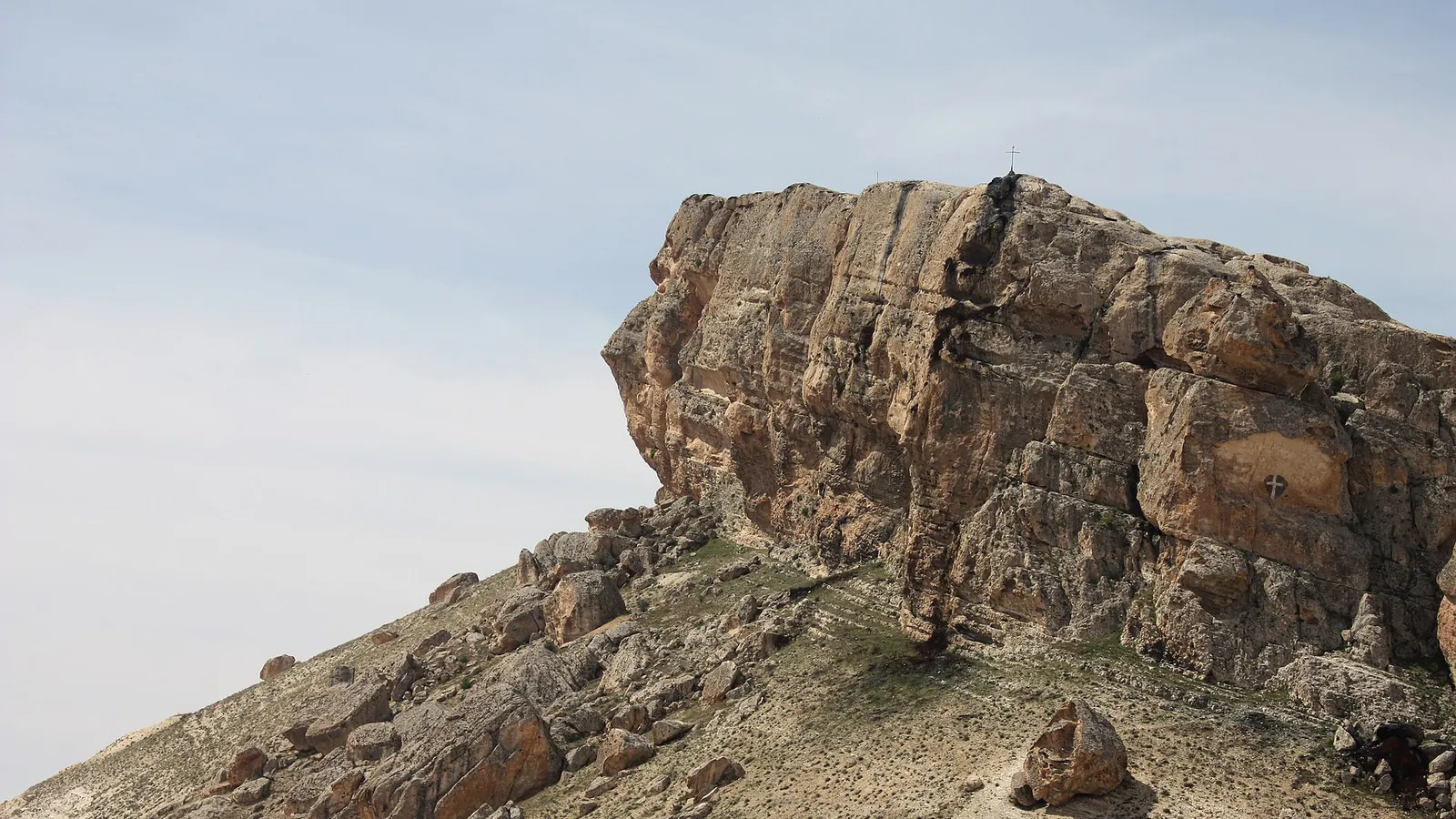
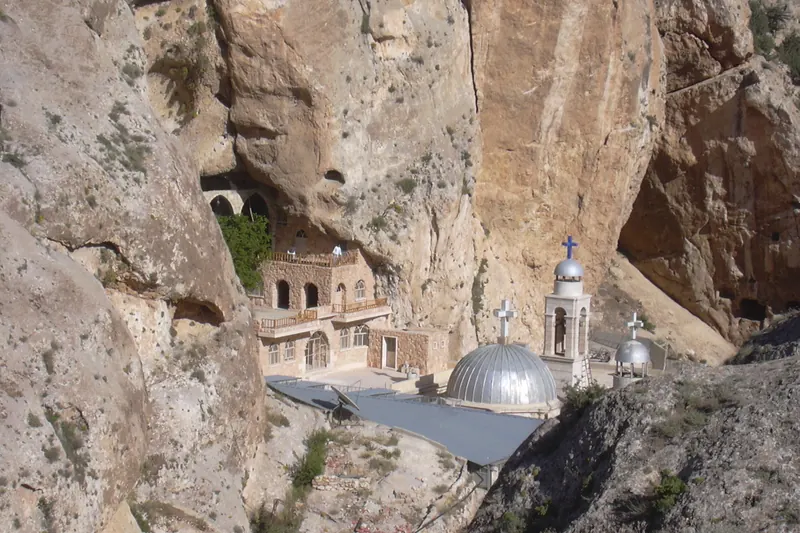
Houses and monasteries built against the rock cliffs of Maaloula, photographed in 2010, before the war

Rif Dimashq Governorate, Qalamoun Mountains · Syria

Maaloula

A cliffside village north of Damascus where people still speak a form of Aramaic, the language of Jesus's time, and where two ancient monasteries sit in a gorge of split rock.

  • Site status Damaged and partly restored
  • Known for Western Neo-Aramaic, the Monastery of Saint Thecla, Mar Sarkis, cliffside houses

Photo: Eusebius · CC BY 3.0

Welcome to Maaloula

Maaloula is a village of about 3,000 people in the Qalamoun Mountains, some 55 km north-east of Damascus, at an altitude of around 1,500 metres. Its houses, painted white and pale blue, are stacked in tiers up the side of a steep sandstone cliff. The name comes from an Aramaic word meaning 'entrance' or 'gateway', and the village is one of the last places where Western Neo-Aramaic, a descendant of the language spoken in Syria and Palestine in the time of Jesus, is still spoken.

The village has been a Christian centre since the earliest centuries. Saint Thecla, a follower of Paul described in an early Christian text, is said to have fled here from persecution and to have been saved when the rock opened to form the narrow gorge above the village. Her monastery, Deir Mar Taqla, is a Greek Orthodox convent built against the cliff, and lower down stands the Monastery of Saints Sergius and Bacchus (Mar Sarkis), built over a pagan temple, one of the oldest surviving Christian sites in Syria.

Maaloula's population was mostly Christian, with a Muslim minority, and the two communities shared the language and the festivals, particularly the feast of the Cross in September. In September 2013 fighters of the Nusra Front and allied groups entered the village, and it was fought over until April 2014. This page describes the village's history, language and heritage, and what is known of its recovery. It is not a guide to visiting.

  • Culture & Arts
  • Historic Site

Why it matters

Why Maaloula matters

Maaloula matters because a language, a landscape and a tradition of living together came together in one small place.

  • A living link to Aramaic

    Western Neo-Aramaic survives in Maaloula and two nearby villages, and it is the closest living language to the one Jesus is thought to have spoken.

  • The gorge of Saint Thecla

    A narrow, winding cleft in the rock, a few metres wide in places, is said to have opened miraculously. It is a place of pilgrimage for Christians, and for many Muslims.

  • Ancient monasteries

    Mar Taqla and Mar Sarkis are among the oldest continuously used Christian sites in the Middle East, with icons and altars that go back to the 4th century.

  • A village of two faiths

    Christians and Muslims lived together and shared the language and holidays, in a way that became a symbol of Syria's mixed society.

  • A dramatic setting

    The houses and monasteries climbing the rock make Maaloula one of the most striking villages in the Middle East.

Main attractions

Key sites and monuments in Maaloula

The following are the main features of the village as they were documented before the war. It is not a visitor route.

  1. The Greek Orthodox Monastery of Saint Thecla at Maaloula

    The Monastery of Saint Thecla (Deir Mar Taqla)

    A Greek Orthodox convent built against the cliff at the head of the gorge, with a chapel over the reputed tomb of Saint Thecla and a spring believed to have healing properties. It was home to a community of nuns.

  2. The Monastery of Saints Sergius and Bacchus (Mar Sarkis)

    A Greek Catholic monastery, with a 4th-century church built over a pagan temple, and one of the oldest known altars in Christianity, used for both bread and wine, with a carved stone with pagan motifs.

  3. The gorge

    A narrow passage in the rock, between high cliff walls, connecting the two parts of the village. Pilgrims walk through it to reach the convent.

  4. The Aramaic language and its schools

    A small language school and cultural institute in the village worked to preserve and teach Aramaic. The Lord's Prayer and other prayers were still recited in the language.

  5. The village houses

    Small cube-shaped houses painted blue and white, built on terraces cut into the cliff, with narrow stairs between them. Many had wooden balconies and courtyards.

  6. The Feast of the Cross

    A yearly festival on 14 September, when villagers of both faiths lit bonfires on the surrounding hills, and pilgrims came to the monasteries.

Condition and access

Maaloula today

Maaloula was attacked and occupied in 2013–2014, and its monasteries were badly damaged and looted. Information about the recovery is limited.

  • The fighting of 2013–2014

    In September 2013, Nusra Front fighters and other groups attacked and took the village. Churches were damaged and icons were destroyed or stolen, and most residents fled. Government forces retook it in April 2014.

  • The abduction of the nuns

    In December 2013, a group of Greek Orthodox nuns from the Monastery of Saint Thecla was taken by armed men and held for about three months, before being released in March 2014.

  • Damage to the monasteries

    Both monasteries were damaged and looted, with icons, altars and religious objects destroyed or stolen. Some were later returned or restored.

  • Return and restoration

    Many residents returned, and churches, houses and monasteries have been repaired with support from the state, churches and international donors. The Aramaic language and the traditions of the village were reported to be recovering, but the community is smaller than before.

  • Advice

    Most governments advised against travel to Syria at the time of writing. Check your government's current advice. This page is not a recommendation to go.

FAQ

Maaloula: frequently asked questions

Is Aramaic really still spoken in Maaloula?

Yes. Western Neo-Aramaic, a descendant of the Aramaic spoken in the region 2,000 years ago, is spoken in Maaloula and two nearby villages, Jubb'adin and Bakh'a. The number of speakers is small, and the war displaced many of them.

Who was Saint Thecla?

A woman described in an early Christian text as a follower of the apostle Paul, who is said to have fled persecution to this area and been saved when a cliff opened. She is venerated as a saint in the Orthodox and Catholic churches.

What happened in Maaloula in 2013?

Armed groups including the Nusra Front attacked the village in September 2013, and most of its residents fled. Nuns from the monastery were abducted in December 2013 and freed in March 2014. The government retook the village in April 2014.

Did the monasteries survive?

Both were damaged and looted but stand today, and repairs and restoration have been carried out. The extent of the loss of icons and other objects is not fully known.

Is Maaloula safe to visit?

Most governments advised against all travel to Syria at the time of writing. This site does not recommend travel. Check your government's current advice.

Is Maaloula a UNESCO World Heritage Site?

No, though its landscape and Aramaic language are of international importance and have been the subject of proposals and campaigns for protection.

Read next

Related travel articles

Where to go

Beyond the Big Names: Places Worth the Detour

The most visited place in a country is rarely its best, and it is almost never its best value. This is a method for finding the destinations that do not make the postcards — and a set of examples from five of the 50 countries on this site.

Heritage

UNESCO Sites Worth Planning a Trip Around

A UNESCO listing tells you a place matters; it does not tell you whether it is worth two days and a detour. This is how to read the list usefully — and which sites reward building a trip around them.

Advertisement